A colorful shower curtain is the single highest-impact, lowest-commitment change you can make to a bathroom, but picking the right one means deciding whether you want it to anchor the room, echo an accent, or disappear into a pattern. That decision drives every other choice, from fabric weight to rod height. The six approaches that follow break down the trade-offs in cost, upkeep, and visual payoff, so you can match a curtain to your actual space instead of chasing a trend.
Key takeaways
- Scale dictates impact: Oversized bold stripes demand a large bathroom wall to avoid visual crowding, while thin, low-contrast stripes suit compact powder rooms.
- Renter-friendly geometry: Geometric patterns with a white or neutral background use standard tension rods and peel-and-stick hooks, leaving zero permanent marks.
- Material determines upkeep: For tropical prints, choose a polyester-cotton blend with a built-in liner; pure cotton versions require a separate vinyl liner and weekly washing to prevent mildew.
- Ombré hides wear best: Gradient designs mask water spots and soap scum between cleanings, making them the lowest-maintenance option for busy households.
Bold Stripe Option for Maximum Impact

A navy-and-white horizontal stripe is the bold stripe option that delivers the most drama per square foot. The repeating pattern pulls the eye sideways, which visually widens a narrow bathroom, ideal if your tub sits in an alcove with less than 60 inches of wall space. Wide stripes (6-8 inches) read as confident and graphic; narrow ones (1-2 inches) trend nautical and calm.
This setup pairs a horizontal striped curtain with a stainless steel rod and chrome fixtures against white subway tile. The metal finishes echo the crisp white between the navy bands, so the curtain becomes the room’s single focal point rather than competing with hardware. The wipe-clean polyester-cotton blend stands up to daily splashes in a high-traffic family bathroom, and the pattern hides water spots far better than a solid dark color.
Hang the rod 6-8 inches above the tub flange and let the curtain break 1-2 inches onto the floor for a polished, tailored line.
Geometric Patterns That Ground Small Spaces

Tessellating shapes, hexagons, diamonds, interlocking circles, turn a colorful shower curtain into an organizing force in a compact bathroom. The repeating motif gives the eye a clear path to follow, which prevents the visual static that abstract prints can create when you only have a few feet of sightline.
In a tight corner with a pedestal sink and chrome faucet, a coral-and-gray hexagon-patterned curtain with simple shower curtain rings delivers that grounding effect. The coral introduces warmth without overwhelming the white fixtures, while the gray anchors the pattern so it reads as structured rather than busy. Choose a pattern where the individual motif measures 4-6 inches across; anything larger overwhelms a 54-60-inch curtain width, and anything smaller turns to visual noise at a glance.
For small spaces, select a polyester curtain with a printed pattern rather than woven-in color. The printing process keeps the pattern crisp at a distance, and the smooth surface wipes clean faster than textured fabric, critical when the curtain sits close to a pedestal sink and daily splashes land within arm’s reach.
Tropical and Botanical Prints for Spa-Like Retreats
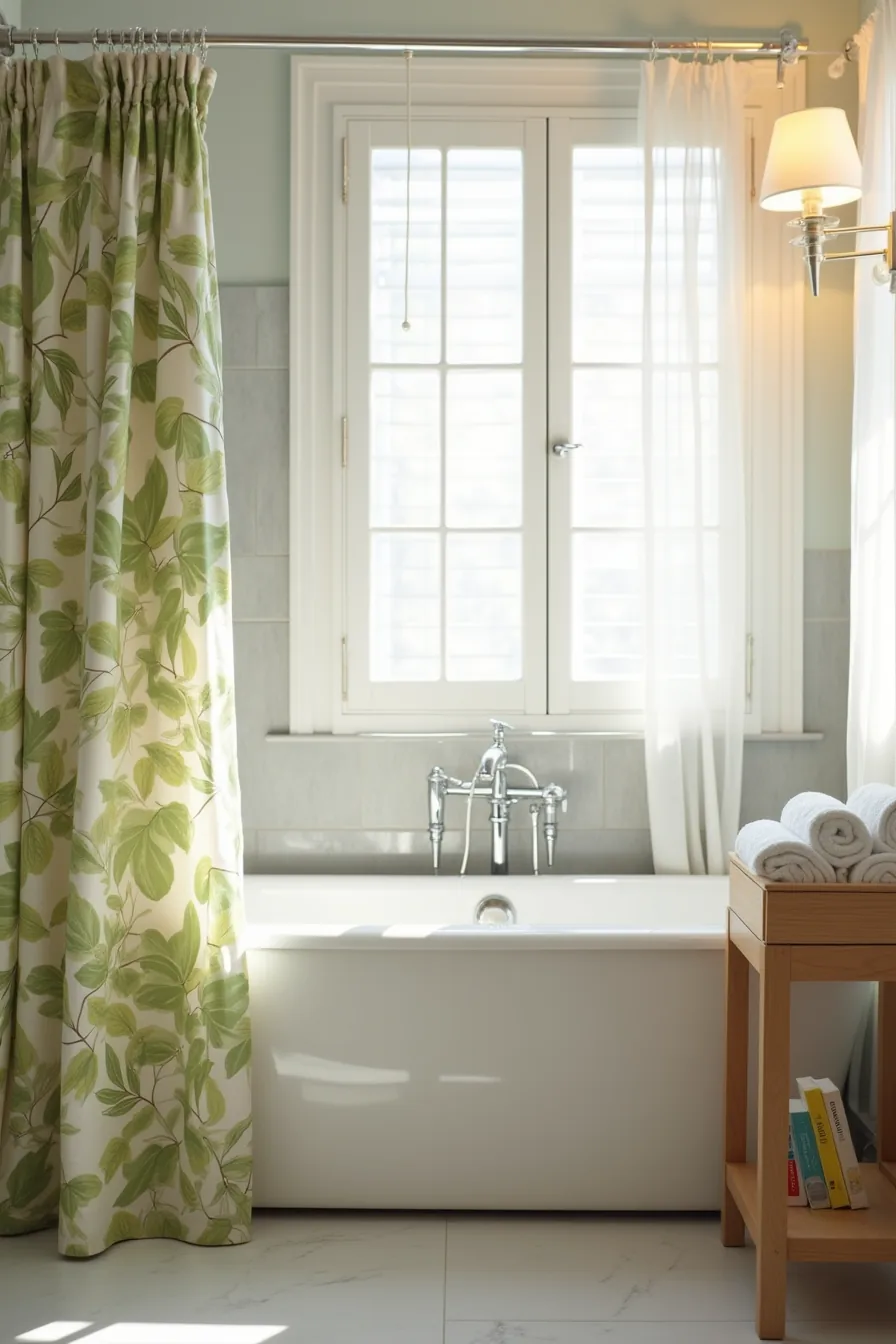
Large-scale leaf motifs, monstera, palm fronds, banana leaves, transform a colorful shower curtain into the room’s emotional anchor. Unlike geometric repeats, botanical prints work best when the individual leaves span 12-18 inches, letting the organic shapes read as lush scenery rather than wallpaper. A green-and-cream leafy curtain pairs naturally with neutral gray tile and white fixtures, pulling warmth from the greenery without demanding bold accents elsewhere.
The wooden bath caddy holding rolled towels on the tub edge reinforces the spa effect, choose teak or bamboo with a water-resistant finish, and expect to oil it every 3-4 months to prevent graying. For detailed prints, select a woven polyester fabric with a moisture-repellent coating; this matters because intricate leaves trap soap scum in their crevices. Machine-wash monthly on cold with bleach-free detergent, then hang dry to keep the deep greens from fading.
Skip this design if your bathroom lacks a window or vent, heavy botanicals in a dark, steamy space can feel swampy rather than serene. For smaller bathrooms, a cream-background curtain with scattered leaves keeps the airy quality while still delivering the botanical retreat effect.
Repeat One Accent Tone Across Coordinating Pieces
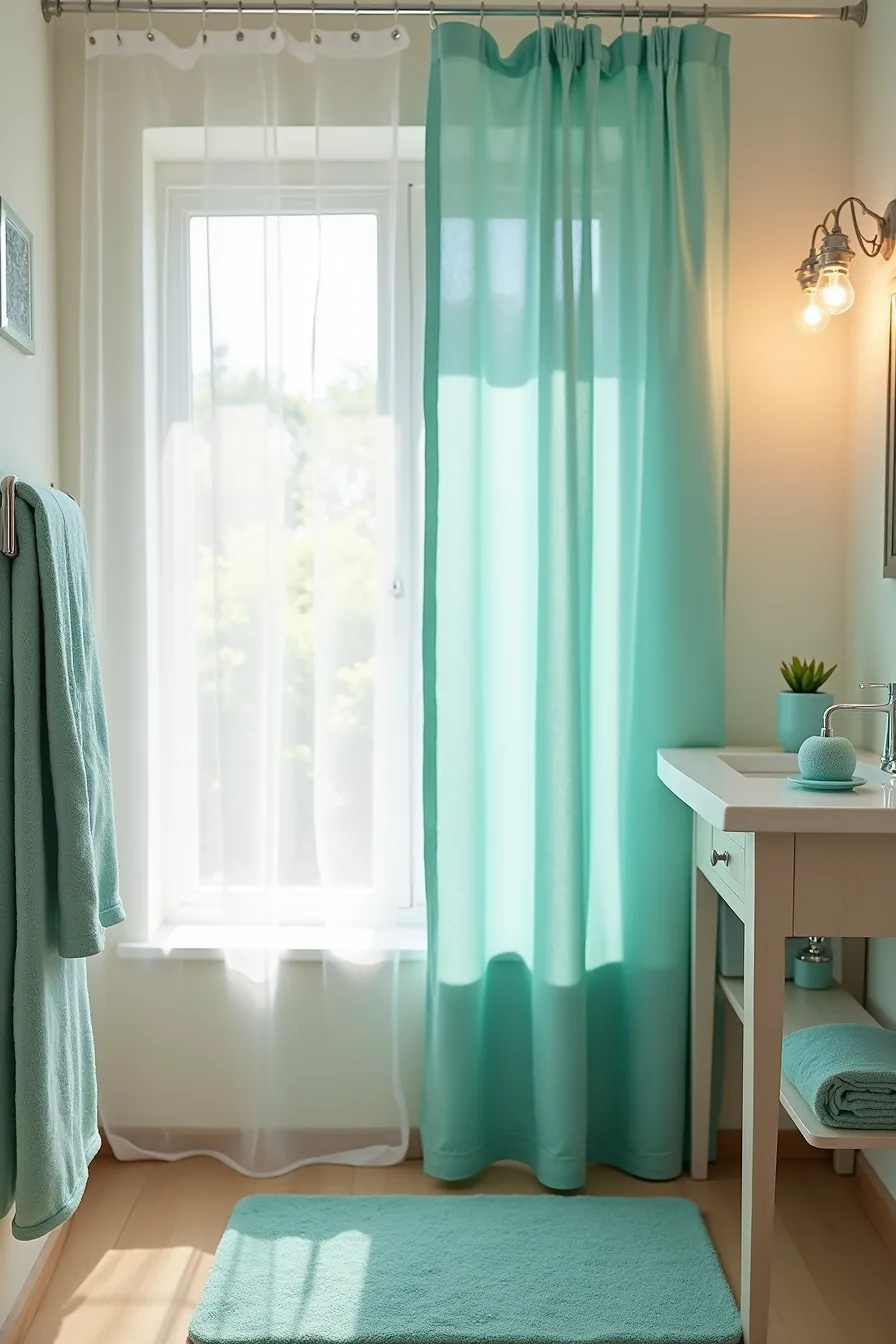
Pick one saturated shade, teal, mustard, coral, and let that single hue travel through every textile you can see from the doorway. A solid teal curtain sets the anchor; a matching teal bath mat and hand towel on a chrome ring complete the triad, while a small teal soap container on the shelf ties the composition without adding visual noise. The effect is immediate cohesion, and it costs far less than you expect: most solid polyester curtains land in the $15–30 range, and you can source coordinating mats and towels from the same color family at big-box stores for under $10 apiece.
This approach suits rental spaces perfectly because nothing requires permanent modification. The chrome ring and shelf are landlord-friendly, and swapping the entire palette takes under an hour when your lease ends. For small bathrooms, restrict the accent to three items, curtain, mat, towel, to avoid color fatigue; larger rooms can absorb a fifth element like a shower cap or wastebasket.
Neutral walls and white fixtures let the accent do all the work, which is exactly the point of a colorful rental refresh.
Color-Blocking for Modern, Minimalist Bathrooms
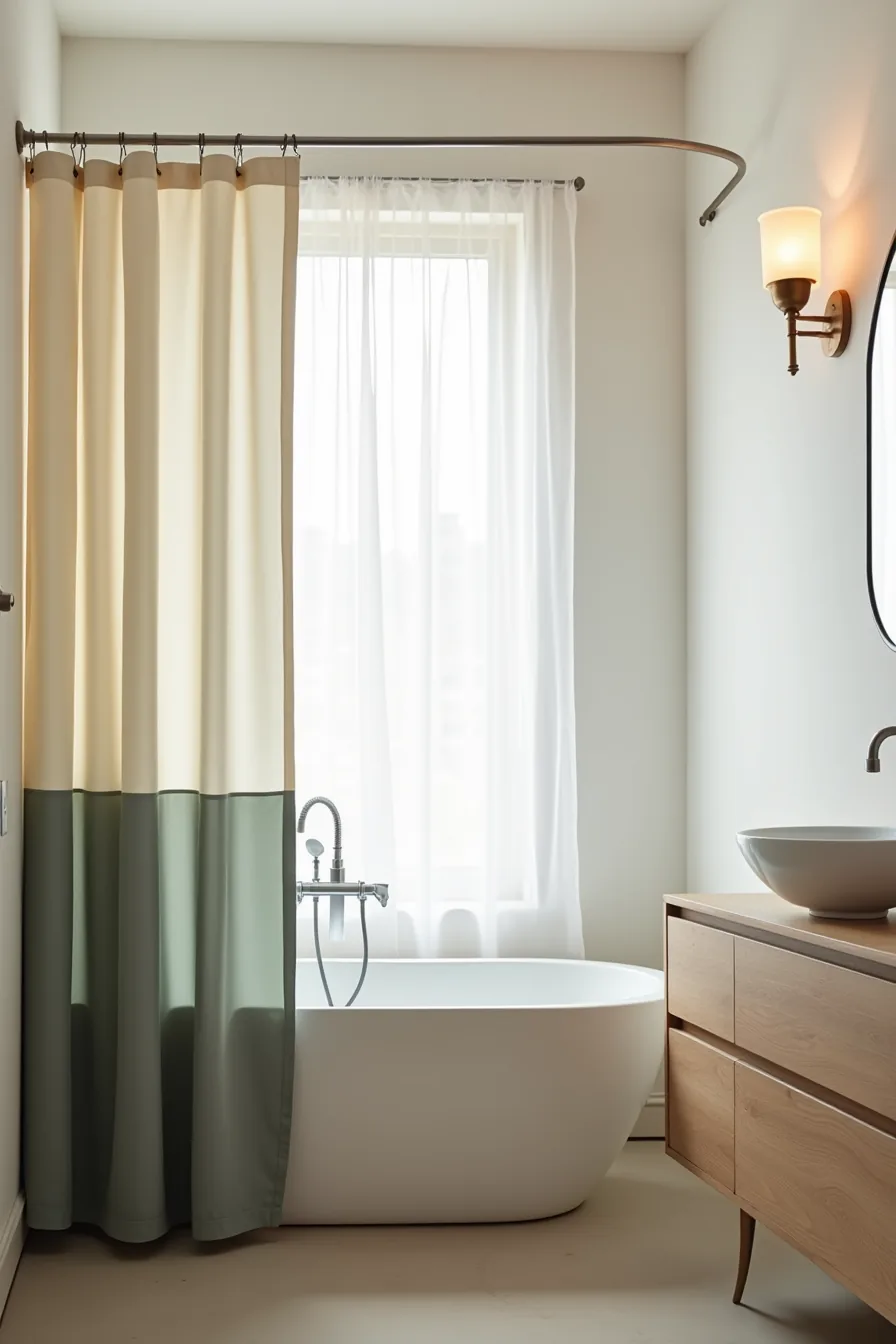
Color-blocking trades a single pattern for two or three solid horizontal sections, creating architectural interest without competing with clean lines. A curtain split into a cream top third, charcoal middle, and soft sage bottom third reads as intentional design rather than decoration, and it works because the separation mimics wainscoting or tile transitions. For contemporary spaces with white porcelain fixtures and a polished concrete floor, this geometric structure grounds the room while the sage section introduces the only softness in the palette.
The proportions matter more than the hues themselves. Keep the darkest section at the bottom, where it visually anchors the tub and hides soap scum better, and let the lightest color occupy the top third to bounce light around a small bathroom. You can achieve this look with a custom-sewn curtain (expect $80–150 from a local seamstress) or by layering two standard curtains, one shorter, one longer, on a dual-rod system.
The latter costs roughly $40 total and lets you swap the bottom section seasonally without replacing the entire setup. This route suits design-conscious renters and minimalists alike, since the chrome rod remains the only permanent fixture.
Ombré and Gradient Designs for Subtle Sophistication
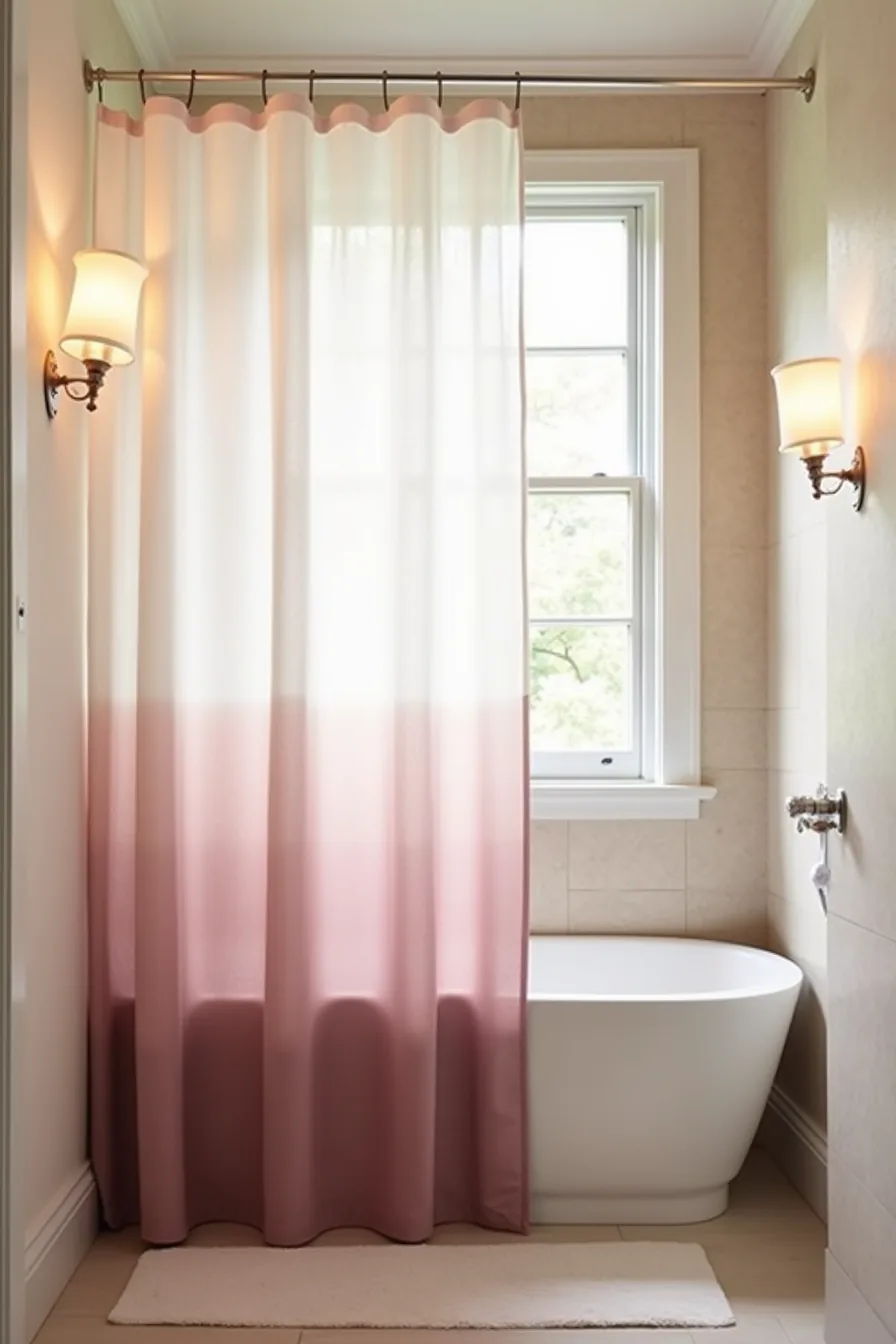
An ombré curtain shifts color gradually rather than in hard stops, which softens the visual weight of a bathroom that leans neutral. In this setup, the transition from pale blush at the top to deep mauve at the bottom echoes the tonal range of natural stone, so the beige wall tile and simple chrome rod stay quiet while the curtain supplies the only drama. Diffused daylight from a nearby window is what makes this work, gradient fabrics rely on even illumination to read smoothly, and harsh overhead spotlights will emphasize the dye lines instead of blending them.
This direction suits transitional bathrooms where you want warmth without pattern commitment. You can find machine-woven gradient options in polyester for $25–45, but the deeper and more smooth the transition, the more likely it’s a hand-dyed piece running $60–100; expect hand-dyed versions to require cold washes and line drying to keep the color migration slow. If your tub sits opposite the window, the gradient will appear more pronounced at the top and fade toward the floor, plan the lightest shade for the upper section so it catches that brightness rather than the darkest tone absorbing it.
Where to start
Start by measuring your shower area and checking the rod clearance, this determines whether you need a standard 72-inch curtain or a longer option. Then pick one anchor color you already love in the room, and buy a curtain that includes it as a secondary shade rather than the dominant hue.
Your next step: order two fabric swatches from an online retailer and hold them against your existing towels and tile before committing. That 10-minute comparison will save you a return shipping fee and a design mismatch.
Frequently Asked Questions
What size colorful shower curtain do I need for a standard bathtub?
Most standard bathtubs need a curtain 70–72 inches wide and 70–72 inches long. Measure your rod length first; if it exceeds 72 inches, choose a wider curtain or add a liner for full coverage.
How often should I wash a colorful shower curtain to prevent mildew?
Wash your curtain every two to four weeks, depending on bathroom humidity. Machine-wash on a gentle cycle with warm water and a half-cup of vinegar, then hang it back immediately to air-dry completely.
Can I use a colorful shower curtain in a rental without damaging walls?
Yes, choose a tension rod that requires no drilling, or use adhesive hooks rated for your wall type. Ensure the rod fits snugly; most tension rods adjust from 40 to 72 inches, so measure your space first.
What colors work best with small bathroom lighting?
Bright whites, soft pastels, and high-chroma colors like turquoise or coral reflect limited light and prevent a cramped feel. Avoid very dark shades, which absorb light and make a small space feel smaller.