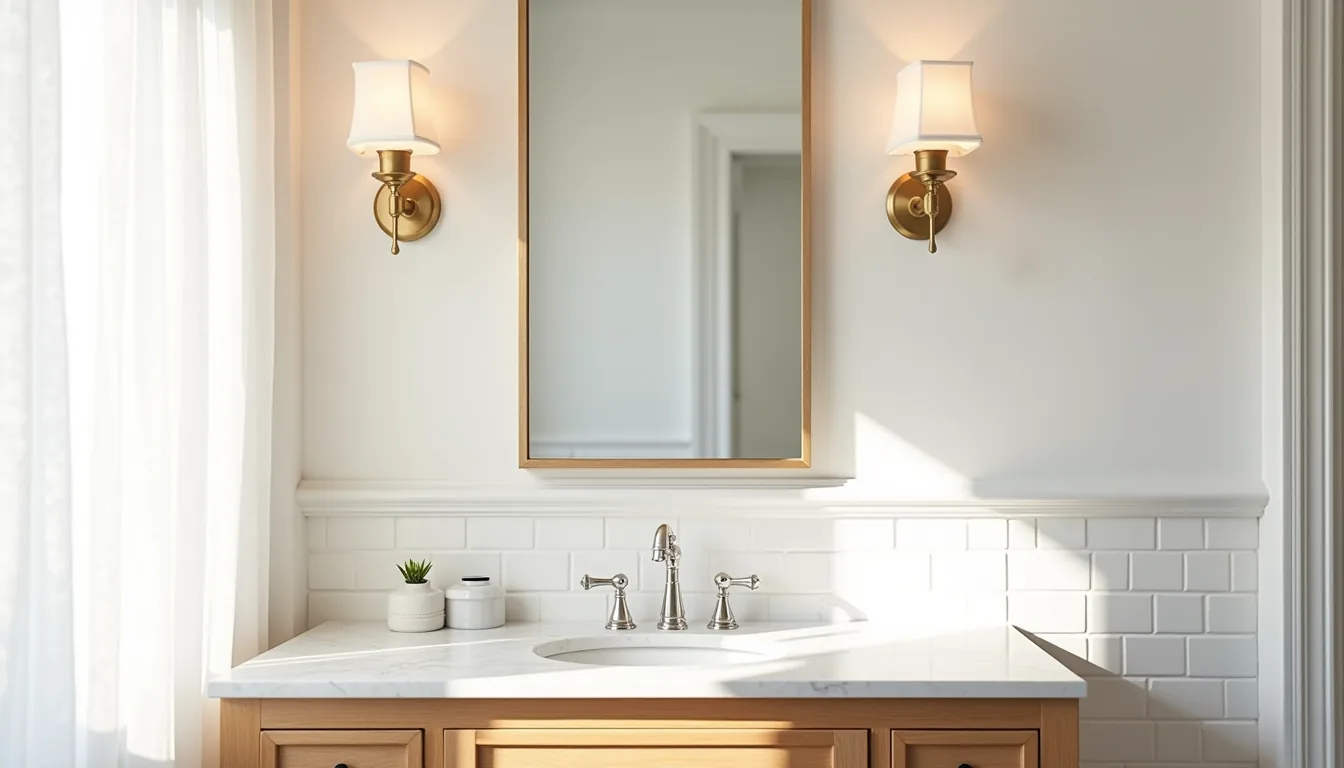

The right bathroom wall lamp does more than illuminate your mirror, it determines how accurately you shave, apply makeup, or check your skin tone, and most standard vanity fixtures get that job wrong by casting shadows across your face. The fix isn’t a brighter bulb; it’s repositioning light to the sides of the mirror at eye level. Below, six distinct approaches, from plug-in sconces to hardwired LED bars, each with the exact placement, sizing, and material trade-offs you need to match your space and budget.
Key takeaways
Pair sconces at eye level (60-66 inches from floor) flanking the mirror for even, shadow-free facial lighting. Match metal finishes between wall lamps and your faucet/hardware, brushed nickel with nickel, matte black with black, to unify the room in under an hour. Install a single fixture 18-24 inches above the mirror’s top edge for compact bathrooms where side clearance is under 24 inches. Layer a dimmable task light at 3000K for morning grooming with a separate warm accent lamp (2700K) for evening relaxation, controlled independently.
Sconce Pairs Flanking the Mirror
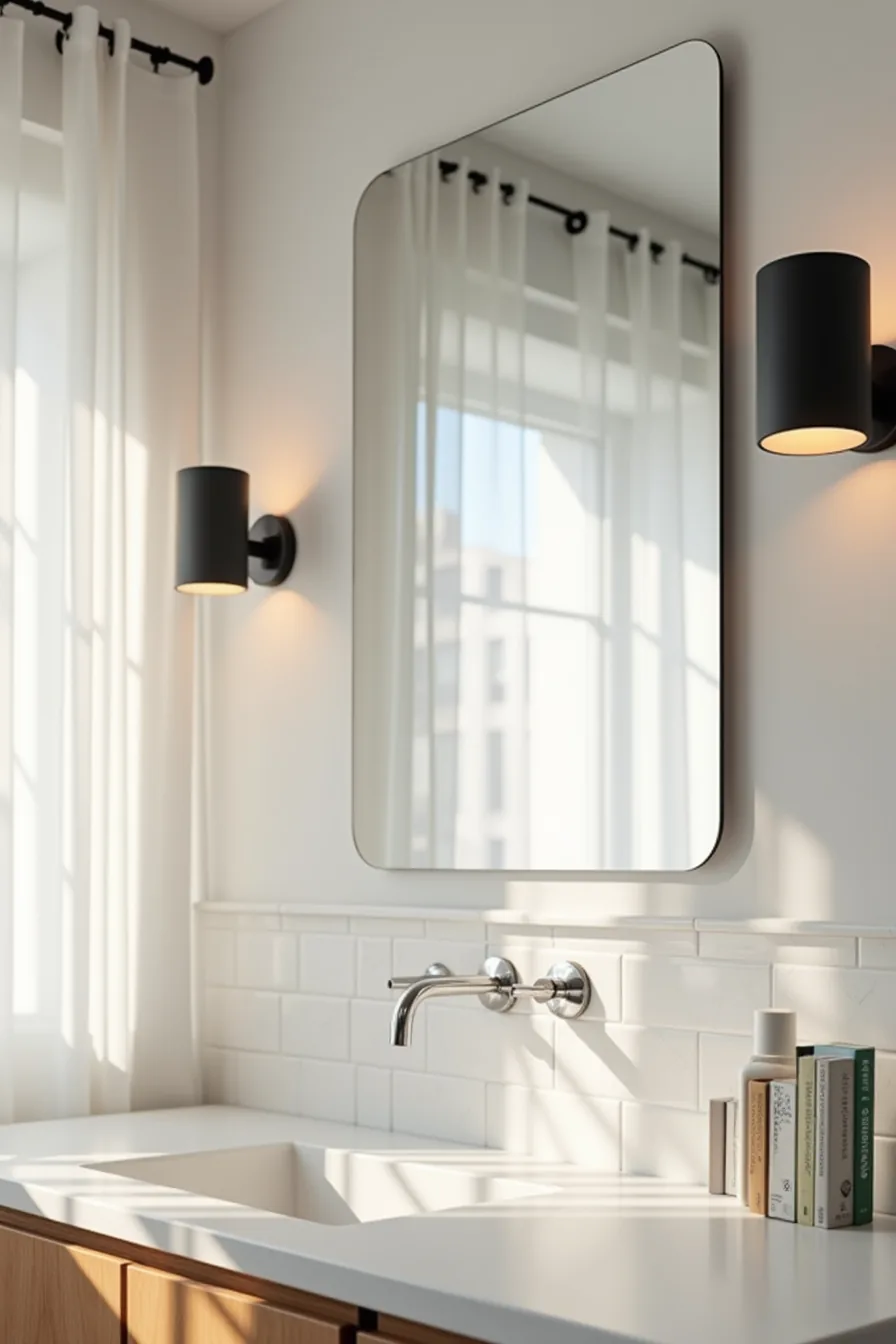
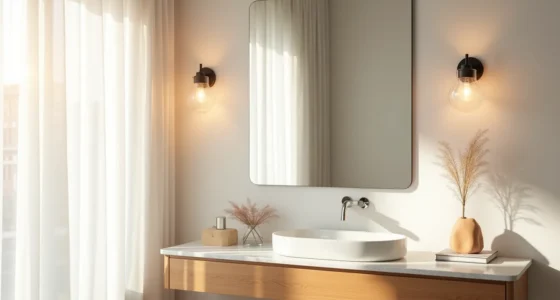
This is the most dependable layout for a bathroom wall lamp because it places light at cheekbone height, where it eliminates shadows cast by a single overhead source. The matte black sconces with cylindrical shades in this setup pair cleanly with the chrome faucet, giving the pale gray wall a deliberate contrast rather than a mixed-metal clash.
Space each sconce 12 inches from the mirror’s outer edges, and mount them 60-66 inches above the floor. For a 36-inch-wide mirror, that puts the fixtures roughly 19-22 inches apart from each other, enough room to wash your face without hitting an elbow. Cylindrical shades direct light horizontally, so opt for frosted glass or a fabric liner if you want to reduce glare while applying makeup.
This arrangement suits medium to wide vanities (48 inches or more) where you’ve the wall clearance. If your mirror is wider than 48 inches, scale up the sconce height or choose longer shades to avoid a top-heavy look. Budget-wise, matte black is the most readily available finish, so you can find quality pairs in the $60-$150 range, though you’ll spend an extra $100-$300 on professional hardwiring if you don’t have existing junction boxes.
Single Overhead-Adjacent Fixture for Compact Bathrooms
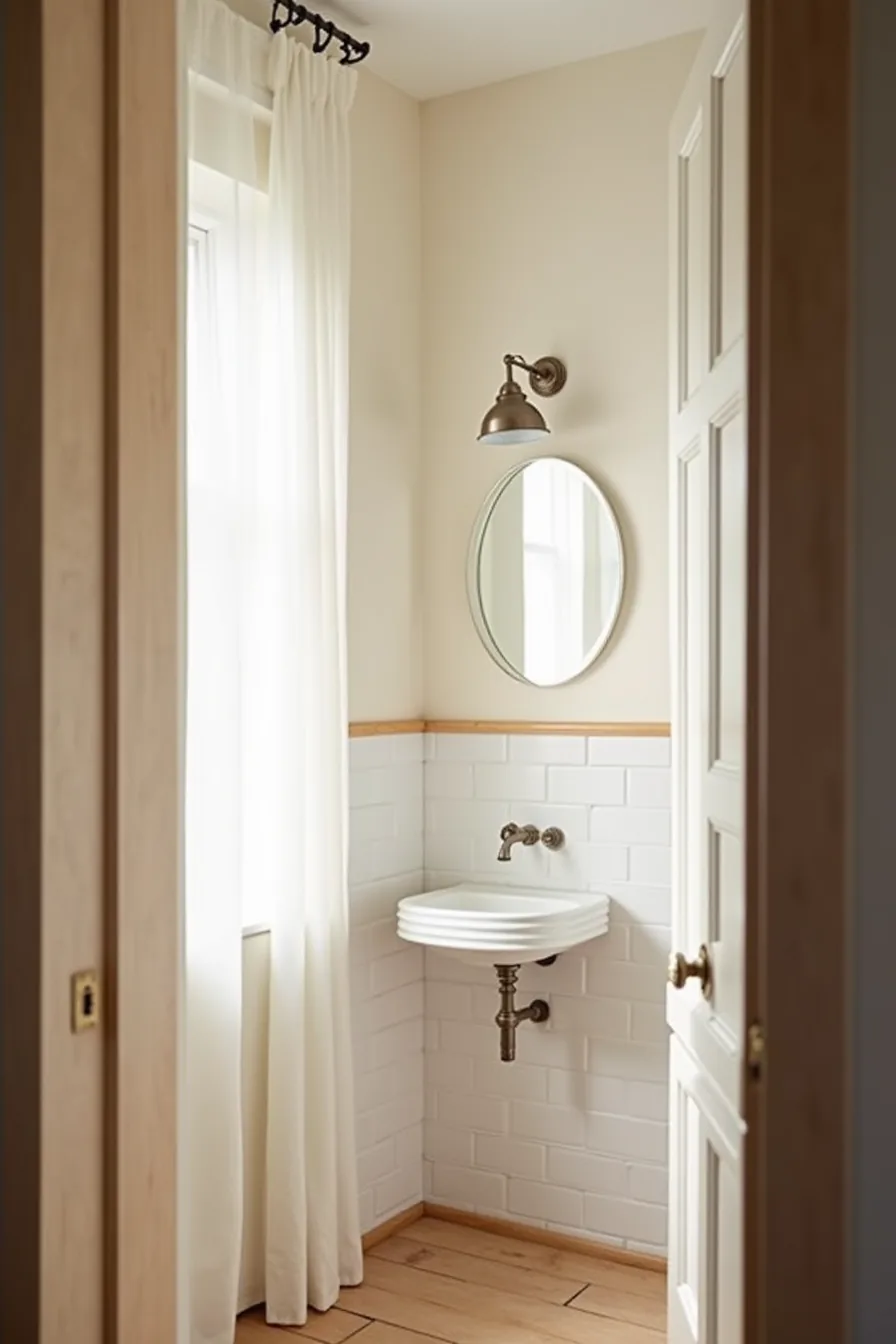
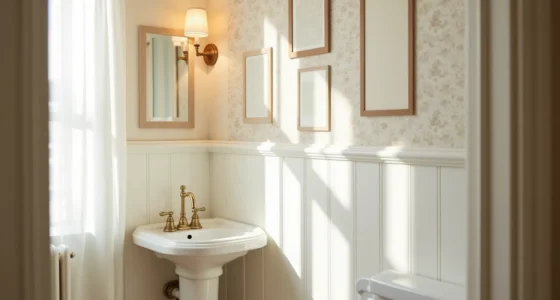
When wall space is tight, a single brushed nickel lamp mounted above and slightly left of a small round mirror delivers task light exactly where you need it, at the sink, without demanding the 24-30 inches of clearance that flanking sconces require. This angled placement works because it throws light across your face rather than straight down, which a ceiling fixture would do, and it suits pedestal sinks where there’s no vanity cabinet to mount anything on.
Mount the fixture 66-72 inches above the floor, with the shade’s bottom edge level with the top of the mirror. A 6-8 inch overhang past the mirror’s edge keeps the bulb’s glow from casting your head’s shadow onto the wall behind you. Brushed nickel pairs naturally with chrome faucets and white subway tile, so you won’t need to introduce a third metal finish into a space this small.
This setup suits powder rooms, half baths, and narrow corner sinks where a 36-48 inch vanity would never fit. The pedestrian-scale footprint, typically a 5-7 inch backplate and an 8-12 inch arm reach, leaves the door swing and towel bar zone untouched. Budget fixtures in this style run $40-$90, and because you’re hardwiring one box instead of two, installation labor drops to roughly $75-$150.
The trade-off: you get even light across the whole face only if you stand centered under the lamp, so it’s a morning-task solution, not a makeup-application one. For a more forgiving option, choose a swivel-arm version that lets you pivot the shade directly at your face when you step up to the sink.
Metal Finish Pairing With Faucet and Hardware
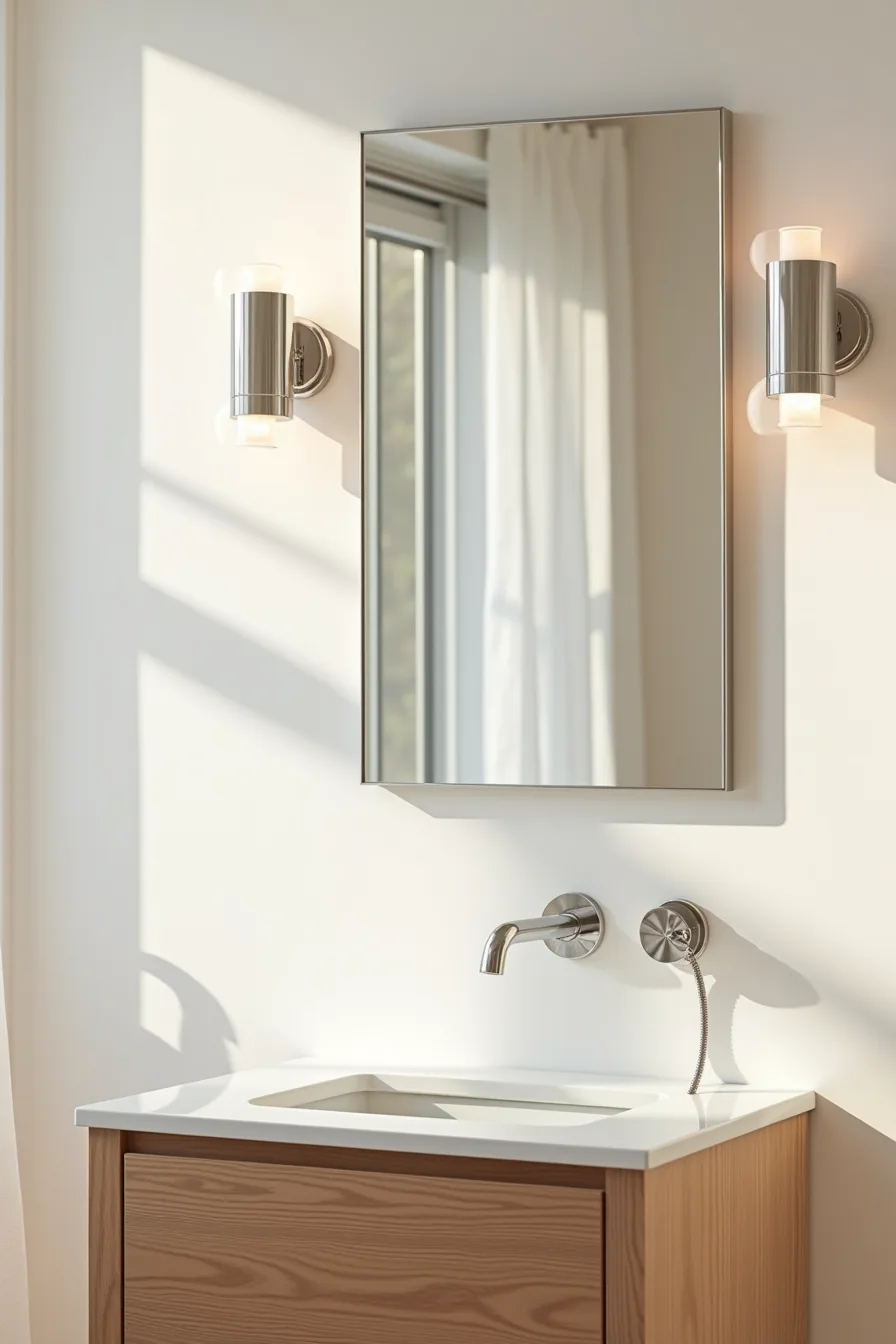
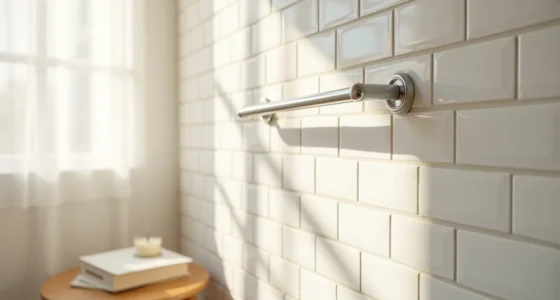
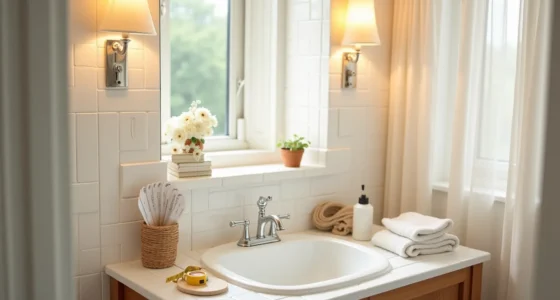
The polished chrome sconces flanking the vanity mirror duplicate the finish on the faucet and the mirror frame, so the wall lamps read as part of a single fixture family rather than separate purchases. This match-everything approach is the safest route when your faucet is chrome or brushed nickel, since those two finishes dominate the mid-range market and are easy to source across brands and price tiers. A stainless steel towel bar in the same cool-toned family completes the loop without demanding an exact alloy match.
For a more deliberate contrast, pair matte black sconces with a chrome faucet. The rule of thumb: keep the metal finish pairing to two families maximum across the entire room. Brass works best as the sole warm accent, so pair it with chrome or nickel hardware rather than adding a third metallic note.
Satin and brushed textures forgive fingerprints better than polished surfaces, a meaningful distinction in a room where hands are frequently wet. If your faucet and mirror frame already clash, the wall lamp can act as the tiebreaker, choose the finish that appears twice already ór, if you’re replacing the mirror, let the lamp’s finish dictate the new frame.
Task Light vs Mood Light: Layering for Morning and Evening
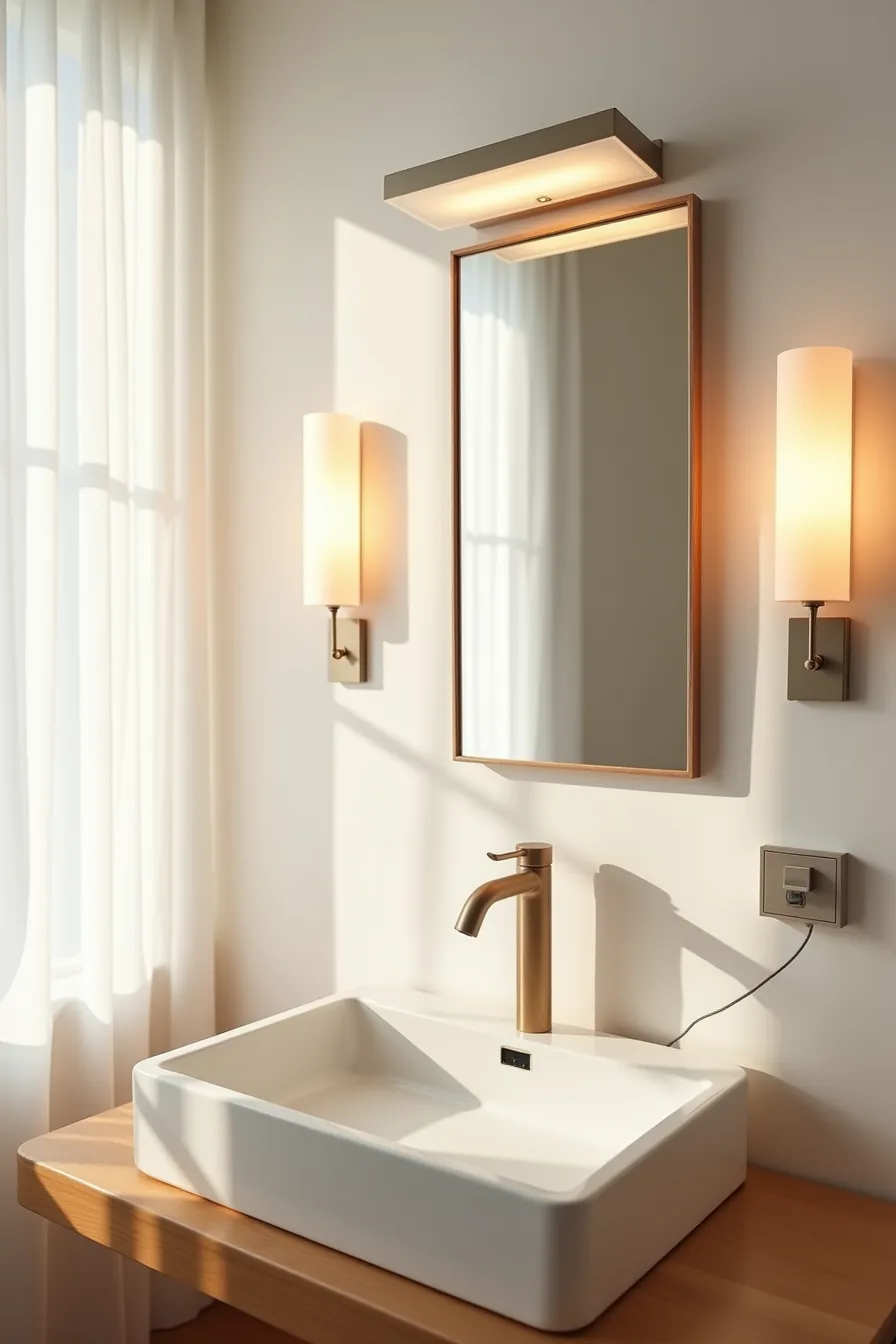
The most effective bathroom lighting setups separate grooming from relaxation rather than forcing one fixture to do both. A bright LED fixture mounted directly above the mirror delivers the shadow-free, high-output light you need for shaving, makeup, or skincare routines, position it so the light source sits at eye level, roughly 60–66 inches from the floor in most bathrooms. That overhead brightness, however, will feel harsh and clinical when you’re unwinding in a bath at 10 p.m.
This is where a second, warm-toned dimmable sconce earns its place. Mounted lower on the side wall, typically 54–60 inches from the floor, it casts a soft amber glow across the room without creating glare on the mirror. The visible dimmer switch lets you scale from a gentle 10% nightlight to 40% for evening bathing, while the LED fixture above stays on its own switch for mornings.
You lose nothing in function: the task light handles precision, the sconce handles atmosphere, and each operates independently when you need it.
Renter-Friendly and Permanent Installation Routes
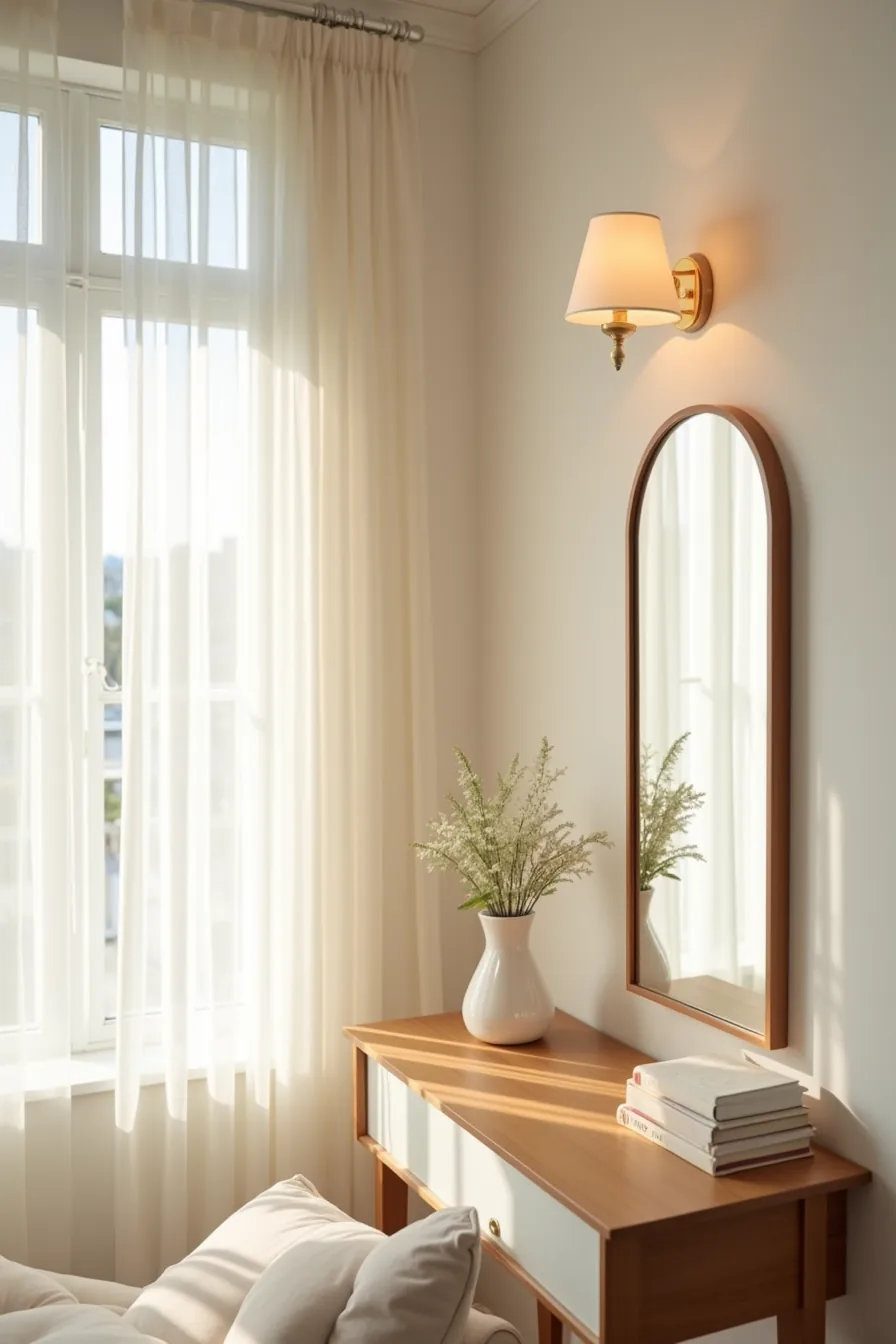
Your lease and your walls dictate which of the two main installation routes you can take. The plug-in version on the left runs a visible cord down to a standard outlet, which you can hang and remove in under ten minutes with nothing more than a screwdriver and a level, expect to pay $40–$120 for the fixture itself, and you can patch the two small screw holes with spackle when you move out. This route suits anyone in a rental, a dorm, or a temporary space, and it carries zero electrical risk.
The hardwired sconce on the right requires a junction box recessed into the wall, visible just above the mirror as the mounting point. An electrician typically charges $150–$400 per fixture for the box, wiring, and switch loop, and you can’t reverse that work without patching drywall. If you own your home or plan to stay put for five-plus years, the permanent route delivers a cleaner profile, no cord, no outlet dependency, and lets you position the lamp exactly where lighting needs demand, not where an existing outlet happens to sit.
Scaling Bathroom Wall Lamp Ideas for Better Morning Light
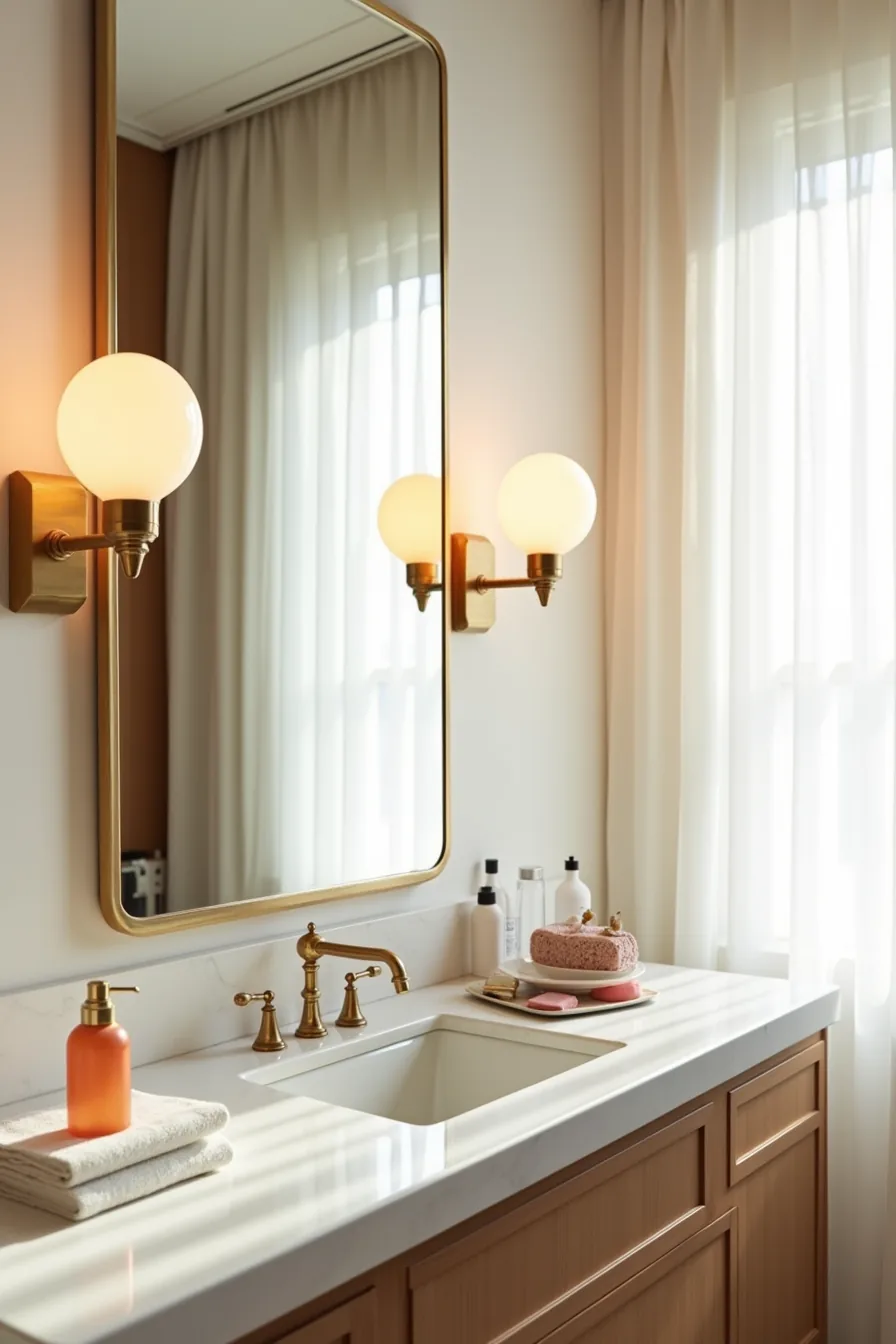
Bulb color temperature does more for your grooming routine than fixture style. The large bathroom setup with two tall brass sconces flanking an oversized mirror runs 4000K bulbs, which cast a neutral white light that renders skin tones accurately, makeup application and shaving both benefit because shadows stay crisp instead of muddy. Warm 2700K bulbs flatter the room but hide blemishes and misapplied foundation, so reserve those for ambient zones away from the vanity.
Placement height follows your eye line, not the ceiling. Mount sconces at 60–66 inches from the floor to the fixture center, with the two brass lamps spaced roughly 60 inches apart so light crosses your face from both sides and eliminates the under-chin shadow a single overhead fixture creates. In a small bathroom, compress that spacing to 36–48 inches and switch to 3000K bulbs, you keep the cross-lighting effect without overwhelming a compact countertop.
For a medium space, extend the sconce spread to match the mirror width exactly; in this large layout, the high ceiling lets the taller brass fixtures carry visual weight while the 4000K output keeps every grooming item on the vanity countertop clearly defined.
Where to start
Sketch your bathroom’s floor plan on graph paper before buying anything. Mark the vanity width, mirror height, and the distance from the floor to your eye level when standing, this determines your fixture’s center point.
Measure twice, then shop. Most bathroom wall lamps sit 66–70 inches above the floor, with the fixture width at roughly one-third of your mirror’s width. If you’re replacing an existing light, remove it first and check the junction box orientation, vertical boxes suit sconces, horizontal boxes favor bar lights.
Your next step: Take three photos of your vanity from straight-on, both sides, and standing at the mirror. Bring them to a lighting showroom or upload them to an online retailer’s live chat. A professional can confirm your scale and placement in under five minutes, saving you a return-shipping fee and a weekend of second-guessing.
Frequently Asked Questions
What wattage or lumen output do I need for a bathroom wall lamp to see clearly while shaving or applying makeup?
Aim for 800–1,100 lumens per sconce, roughly equivalent to a 60–75W incandescent. Position two sconces at eye level flanking the mirror to eliminate shadows. Choose 2700–3000K color temperature for natural skin tones.
Can I install a bathroom wall lamp myself, or do I need an electrician?
You can replace an existing fixture yourself if wiring is intact and power is off. New circuits, GFCI outlets, or wall rewiring require a licensed electrician, typically $150–$400 per fixture. Check local codes; bathrooms mandate GFCI protection within 3 feet of water sources.
Should bathroom wall lamps be dimmable, and what’s the cost difference?
Dimmable sconces are worth it for late-night use and ambiance. Expect $10–$30 extra per dimmable fixture plus a compatible dimmer switch ($15–$50). Standard LED dimmers work with most modern bulbs, verify compatibility before purchase.
How far apart should two wall sconces be placed on either side of a bathroom mirror?
Space sconces 36–40 inches apart, centered on the mirror’s edges. Mount them 60–66 inches from the floor to align with your face. For mirrors wider than 36 inches, increase spacing proportionally but keep each sconce 6–8 inches from the mirror’s outer edge.