
Vintage shower curtain ideas work best when you treat the pattern as the room’s anchor, not a nostalgic afterthought, and match the scale of that pattern to your bathroom’s actual dimensions before you commit to a single purchase. That means a bold 1960s florals print will overwhelm a 32-inch-wide alcove, while a faded toile demands a larger canvas to breathe. The six approaches that follow each solve a specific spatial or budget problem, from a $30 DIY tea-dye to a custom linen panel that will outlast your plumbing.
Your decision hinges on three variables: your wall clearance, your ventilation setup, and whether you rent or own.
Key takeaways
Retro floral curtains work best in small bathrooms when the print scale stays under 6 inches and the background is white or cream to avoid visual crowding. A muted vintage palette (sage, dusty rose, powder blue) reads as timeless and suits north-facing rooms, while jewel tones (emerald, burgundy, navy) add drama but require bright lighting to avoid a cave effect. Renter-friendly swaps use tension rods or adhesive hooks rated for 10–15 pounds, letting you change curtains without drilling or leaving residue. Investment-grade linen or cotton curtains (typically $60–$150) resist mildew better than polyester blends but demand weekly airing and monthly machine washing on a gentle cycle.
Retro Floral Mood: Botanical Prints That Anchor Small Bathrooms
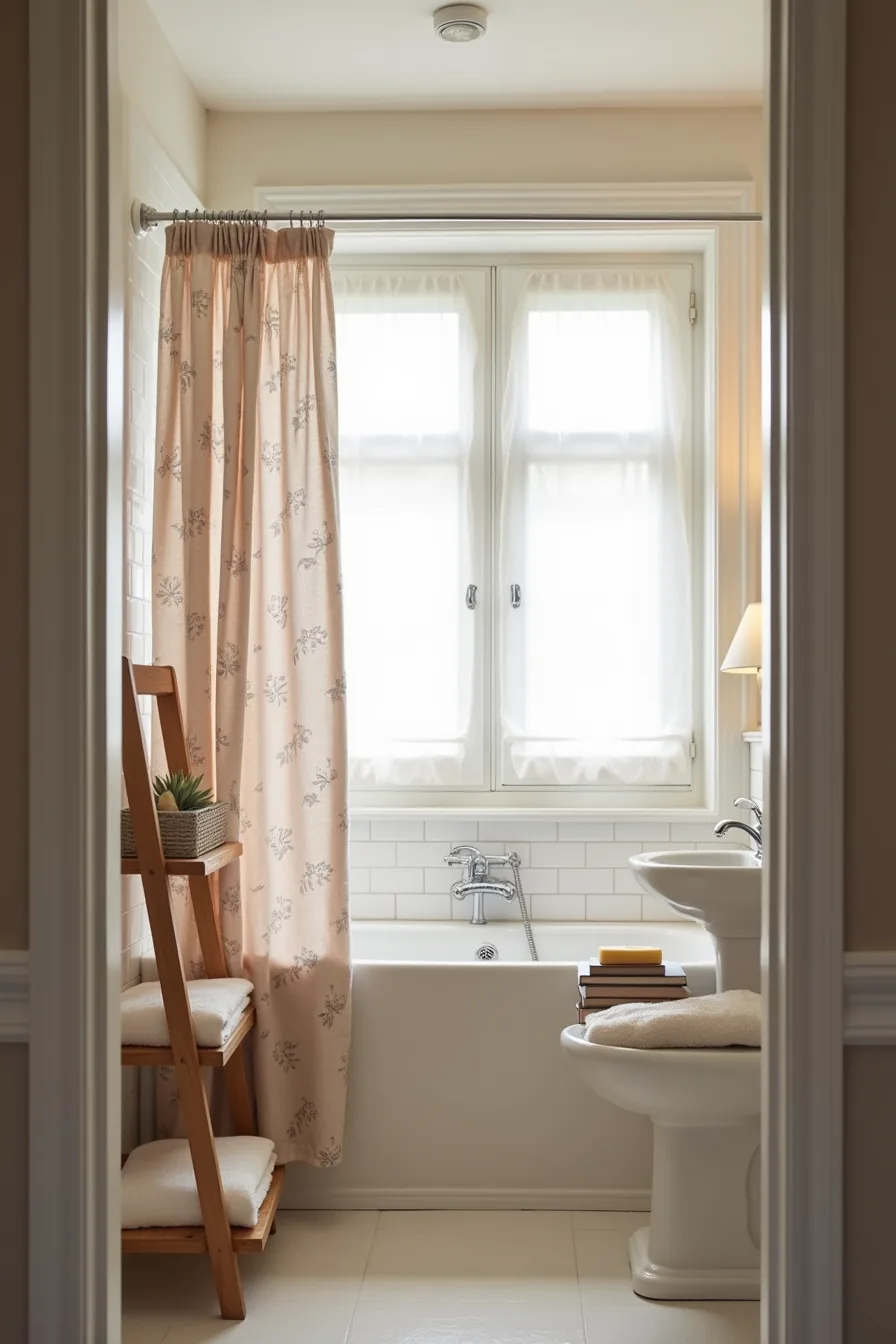
A vintage rose-and-leaf curtain in muted mauve does more than decorate, it gives a compact bathroom a focal point that draws the eye horizontally across the full width of the tub. When you pair it with a chrome rod and white ceramic tile surround, the soft botanical tones prevent the space from feeling clinical while the simple hardware keeps the look grounded.
This approach suits renters and homeowners alike because the curtain itself does the heavy lifting, no paint, tile, or permanent changes required. Choose a pattern where the flowers scale to roughly one-third the width of your shower opening; oversized blooms overwhelm a 54–60-inch rod, while tiny prints read as visual noise. The wooden ladder holding rolled towels adds functional storage without consuming floor space, and a single bar of vintage soap on the sink rim ties the scent and style together.
For maintenance, expect to wash a polyester-blend curtain monthly on cold and line-dry it to preserve the print’s color depth. Muted mauve hides soap scum better than white but shows hard-water spots, vinegar rinses every six weeks keep it crisp.
Vintage Color Palette: Muted Tones vs. Bold Jewel Hues

Your first strategic decision is saturation, not pattern. Muted tones like a soft sage-green curtain read as faded and romantic, ideal for bathrooms with cool gray subway tile where you want warmth without contrast. Bold jewel hues, such as a deep emerald curtain with ornate detailing, create a dramatic anchor that suits larger spaces or rooms with abundant natural light, they absorb brightness rather than reflect it.
Match your choice to the room’s existing conditions. Muted sage complements white or beige fixtures and small windows, while jewel emerald elevates brass or gold hardware and works best when your tile is neutral. A muted palette suits anyone wanting a quiet, hotel-like retreat; jewel tones fit those who prefer maximalist personality and don’t mind a curtain that dominates the visual field.
Both options hang on matching rods and require the same monthly cold wash, but jewel tones hide water spots better between cleanings. For hard-water areas, expect to run a vinegar rinse every four to six weeks on either color to prevent mineral film.
Old-Style Pattern Modern Bath: Mixing Vintage Prints With Contemporary Fixtures

A damask or floral print feels current when you pair it against hard, clean-lined fixtures, the contrast does the work, not the pattern itself. You can see this in a setup combining a cream-and-taupe damask curtain, a floating white vanity, and brushed-metal hardware. The trick is asymmetry in material weight: the fabric carries soft texture, while the vanity and polished concrete floor carry visual mass, so nothing competes for dominance.
This arrangement suits a bath 5 by 8 feet or larger where the shower occupies a corner. The recessed ceiling lighting prevents the damask from looking shadowed or heavy; if you only have a single vanity light, swap for a warm white 2700K-3000K bulb to keep the curtain from yellowing. Ensure your shower rod extends 6-8 inches past the curtain’s outer edge, this keeps the print off a sliding glass door you might otherwise need, preserving the open feel.
The floating vanity also clears the floor, aiding airflow and limiting mildew growth behind the curtain’s lower hem.
Renter-Friendly Vintage Curtain Swaps: Temporary Installation Methods

A vintage striped curtain works without a single drilled hole when you pair an adhesive tension rod with magnetic hooks. The adhesive mounts grip tile or smooth fiberglass for as long as you need them, and they peel off cleanly when you move, just avoid textured or porous surfaces, where the bond weakens within a few weeks. Magnetic hooks on a metal rod let you adjust the curtain’s height or swap it for a second option in seconds, which matters when your bath’s proportions differ from the previous tenant’s setup.
Choose a fabric that hangs well without hemming, like a crisp cotton or a poly-cotton blend with some body, thin vintage linens will puddle and trap moisture against the floor. Store a spare folded curtain in a clear bin on an open shelf so you can rotate patterns seasonally or swap in a fresh one while the first is in the wash. This setup suits any bathroom under 60 square feet where you can’t alter the walls, and your total investment stays under the cost of a single custom rod.
Vintage Shower Curtain Ideas for Cozy Autumn Bathrooms

Fall bathrooms call for deeper saturation and tactile warmth, and a burnt-orange harvest-pattern curtain delivers both without a full redesign. Choose a curtain printed with small-scale wheat sheaves or persimmons rather than oversized motifs, at typical stall widths of 70-72 inches, large prints overwhelm a 54-60 inch tub enclosure and make the room feel smaller. Pair it with a rust-colored bath mat that repeats the curtain’s darkest tone, pulling the eye horizontally and anchoring the space.
Layer in the accessories you would expect to see in an autumn kitchen: a small wooden shelf holding folded amber and ochre towels, plus dried wheat stalks in a clear glass vase on the sink. The straw texture contrasts with the curtain’s smooth cotton, creating the depth that makes a seasonal vignette feel intentional rather than themed. Stick to a palette of burnt orange, rust, cream, and ochre, limiting yourself to three or four warm tones prevents the harvest look from crossing into holiday kitsch.
For small bathrooms under 50 square feet, keep the curtain at full length to avoid a visual break that chops the wall; in larger spaces, hang it higher than the rod, mounting the rod 6-8 inches above the tub rim elongates the pattern and draws the eye upward. Maintenance is straightforward: machine-wash the curtain cold on a gentle cycle with mild detergent every 4-6 weeks, and tumble dry low. This interpretation suits renters and homeowners alike, works in any bathroom with standard tub dimensions, and costs roughly the same as a plain white curtain, just swap in seasonal towels and you’re done.
Investment-Grade Vintage Curtains: Quality Fabrics and Long-Term Care

When you want vintage style that lasts a decade rather than a season, invest in heavy linen or washed Belgian flax. These fabrics typically weigh 8-10 ounces per square yard, noticeably denser than the 4-5 ounce cotton duck used in most mid-range curtains, which means they drape in deep folds rather than hanging flat. A beige linen curtain in this weight reads as vintage through its slubby texture and subtle color variation, not through a printed pattern, making it the most versatile interpretation of the look.
You’ll pay 3-5 times more than a polyester curtain, but the trade-off is genuine mold resistance: linen’s natural breathability lets moisture evaporate instead of trapping it against the liner. Hang it from an ornate brass rod in an oil-rubbed or unlacquered finish, and pair it with a humidity monitor mounted on the wall, when readings stay above 60% for more than 48 hours, run the exhaust fan longer or crack a window. Keep a small cotton cloth on a brass hook near the rod and wipe the liner’s bottom edge weekly; this single habit prevents the soap-scum ring that ruins most curtains by month nine.
Wash linen every 8-12 weeks in cold water with a gentle detergent, never fabric softener (it coats the fibers and reduces breathability). Replace the curtain when you see threadbare patches near the grommets or persistent mildew spots that survive two washings, usually at the 5-7 year mark. Repair small snags immediately with a needle and matching thread; a 10-minute fix beats a $150 replacement.
This route suits homeowners with permanent fixtures and anyone who treats the bathroom as a long-term design commitment rather than a rental staging area.
Your Next Step
Start with the one route that matches your current constraints, not the one you find prettiest. If you rent, buy a 72-inch fabric panel with grommets and a tension rod, under $40 and reversible. If you own and want longevity, budget for a 600-thread-count cotton duck liner behind a vintage-sourced topper.
Measure your tub width and ceiling height before ordering anything; shower curtains run 70–72 inches standard, but alcove tubs vary by 2–3 inches. Then pick one texture, cotton, linen, or vinyl, and commit to its care routine.
Order your curtain this week, hang it, and evaluate the light and airflow within 24 hours. That test tells you more than any Pinterest board can.
Frequently Asked Questions
What fabric weight works best for vintage shower curtains in humid bathrooms?
Choose medium-weight cotton or linen, around 200-300 GSM, which drapes well yet dries reasonably fast. Heavier canvas traps moisture; lightweight sheers cling and mildew.
Can you hang a vintage shower curtain over an existing modern liner, or do you need to replace it entirely?
Yes, hang it over a standard PEVA or vinyl liner with a separate rod. Keep the liner inside the tub; the vintage curtain stays outside, no need to replace anything.
How do you prevent mildew on vintage cotton or linen shower curtains?
Run a dehumidifier or fan during and 30 minutes after showers. Weekly, spray with 50/50 white vinegar and water, then air-dry fully. Never leave it bunched wet.
Are vintage shower curtains from thrift stores safe to use without washing first?
No, wash in cold water with mild detergent on a gentle cycle, then air-dry. This removes dust, mold spores, and residual chemicals. Skip bleach unless the fabric label permits it.