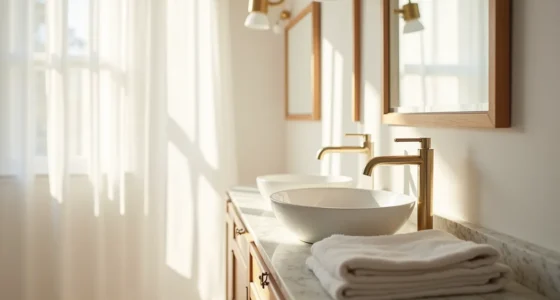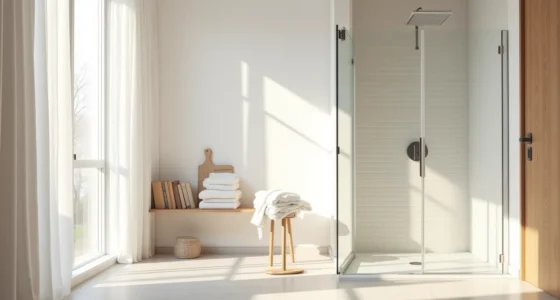
A bathroom lamp only earns its place when it solves a specific problem, whether that’s eliminating shadow on your face at the mirror, adding warmth to a cold tile scheme, or making a small room feel larger, so before you buy anything, decide which job the light must do. That single decision narrows your options from endless to manageable. The six setups that follow cover every budget, rental restriction, and room size, with the exact placement and wattage trade-offs you need to avoid a costly mistake.
Key takeaways
- Fixture choice matters: Match your lighting type to the layout, sconces flanking a mirror are best for small vanities under 36 inches, while a single pendant over a double sink can leave your face half-shadowed.
- Height is non-negotiable: Mount sconces at 60–66 inches from the floor to center light on your face, not your chest, and keep them 28–36 inches apart to prevent harsh unblended shadows.
- Budget route prioritizes adapters: Renter-friendly plug-in sconces with swivel arms attach to existing outlets and run $20–$50, offering identical task lighting without any wiring changes or wall damage.
- Split your circuits for mood: Install a dimmer switch on a separate circuit for your overhead fixture, typical cost is $50–$150 for installation, so you can drop to 20% brightness for evenings without compromising on task brightness in the mornings.
Sconce vs Pendant: Which Fixture Type Suits Your Layout

Your ceiling height and counter depth decide this contest before aesthetics enter the room. Wall-mounted sconces win in bathrooms with ceilings under 8 feet or vanities positioned in high-traffic paths, where a hanging fixture would intrude into your personal space as you lean toward the mirror. For that low-ceiling setup, mount brass sconces at roughly 60 inches from the finished floor, flanking the mirror at shoulder width, this places light at cheekbone level, which is what eliminates under-eye shadows during shaving or makeup application.
Pendants earn their place in taller rooms, particularly above a freestanding tub where nothing obstructs the swing. Hang the fixture so its bottom edge sits 24 inches below the ceiling when the ceiling exceeds 9 feet, keeping the shade well above your head when you step in and out of the bath. The trade-off: pendants cast a downward pool of light that flatters the tub but leaves the vanity counter darker, so pair them with a separate task light.
If your layout has both a low vanity zone and a high ceiling over the tub, you can use sconces at the mirror and a pendant over the bath without conflict.
Mirror-Side Lighting for Even Task Illumination
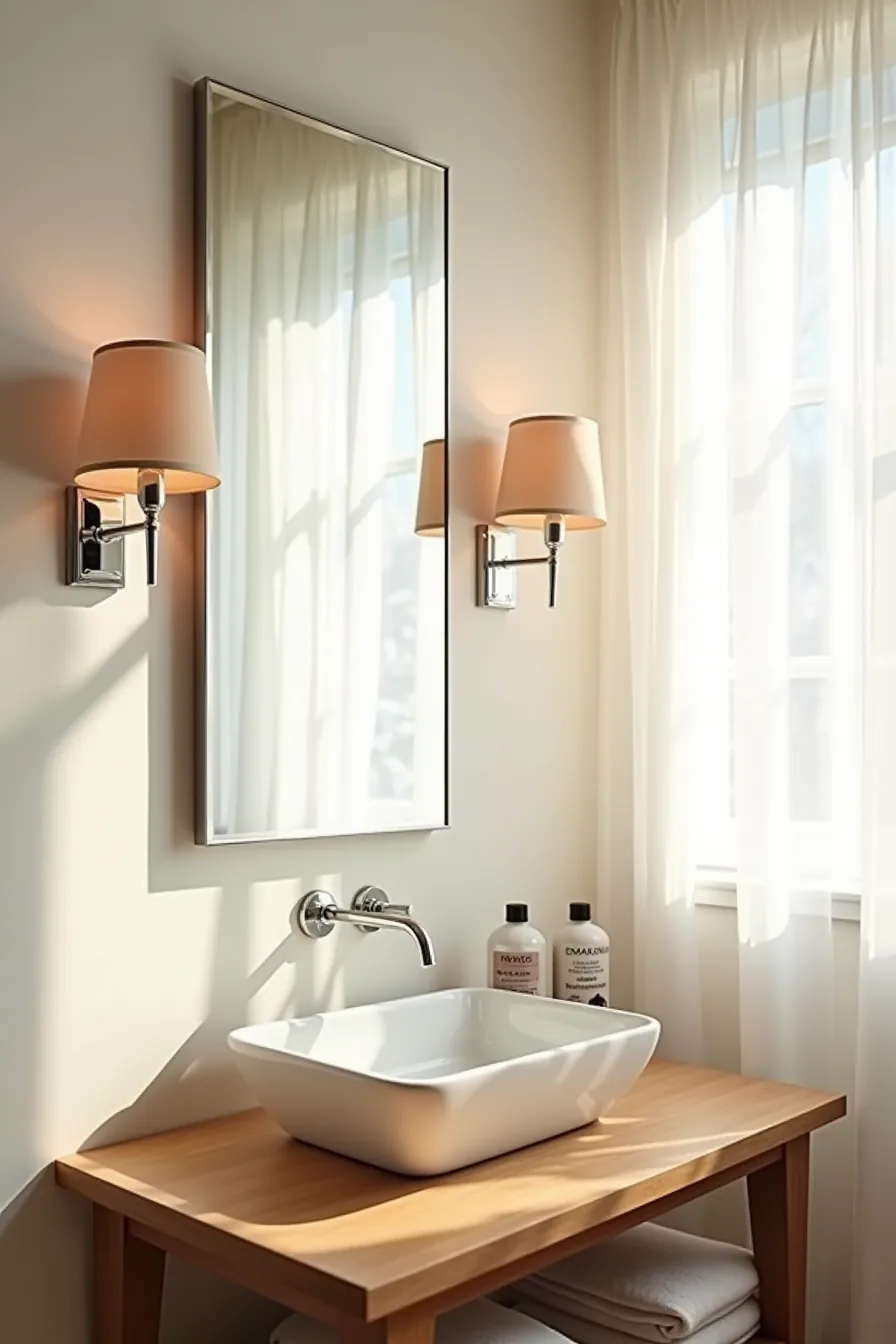
Mirror-side lighting solves the problem overhead fixtures create: shadows cast by your own head across the face plane. Two chrome sconces positioned 36 inches apart on either side of a rectangular mirror accomplish this by crossing light at the center of your face. Mount them at 66 inches from the finished floor, which aligns the light source with your eyes rather than your chin or forehead.
For the vanity counter and ceramic sink basin beneath, this placement ensures the entire work surface receives light at the same intensity, no dark pockets near the drain or the back edge. Choose bulbs in the 2700K to 3000K range for accurate color rendering during grooming tasks. In small bathrooms, space the sconces 24–30 inches apart if your mirror is narrower, but never mount them closer than 6 inches from the mirror’s edge or you’ll create a hot spot on the frame.
Overhead Fixtures That Don’t Create Harsh Shadows

A flush ceiling fixture with a frosted glass diffuser doesn’t have to cast unflattering downward shadows when paired with the right strategy. The frosted glass spreads light broadly across the room, raising the overall ambient level so the contrast between lit and unlit areas shrinks dramatically. The fixture should sit centered over the vanity bowl itself, not the room’s center, so its diffused glow lands on the counter edge first, then spills outward.
Layering is what prevents the dreaded single-source shadow. Your wall sconces at mirror height work as the task layer, while the ceiling flush mount acts as the fill light. The sconces illuminate your face, and the frosted overhead washes away the shadows your body would otherwise cast onto the tile backsplash and the countertop.
For a standard 5-foot vanity, a 12-to-16-inch diameter flush mount keeps the proportion correct; anything larger visually crowds the sconce pair. Choose a diffuser with a high light-transmission rating, look for fixtures that state their efficiency. You’ll need a 2-to-3-inch gap between the glass and the ceiling plane to prevent heat buildup.
Budget route: swap the flush fixture for a plug-in pendant on a short chain, hung 24 inches off the ceiling, no hardwiring required. Renter-friendly: use a battery-operated puck light adhered inside a frosted glass bowl shade, clipped onto an existing hook; it reads as intentional, not temporary.
Bathroom Lamp Ideas for Brighter Morning Routines

To trigger alertness while you prep, target a 5000K color temperature at the mirror plane, daylight mimics the morning sky and suppresses melatonin more effectively than warm 2700K bulbs. The LED sconces flanking your mirror should be mounted at eye level, roughly 60-66 inches from the floor, with their light aimed inward toward your face rather than outward onto the wall. That placement eliminates under-chin shadows, which is the difference between seeing your skin clearly and guessing at it.
The overhead fixture in this setup runs at the same 5000K to keep your eyes from adjusting between light sources, and the small task lamp on the counter edge adds a focused third layer for detail work like tweezing or eyeliner. You’ll need dimmable drivers on all three circuits if you want to drop to 3000K in the evening, fixed 5000K will feel clinical after 8 PM. Budget route: swap the sconces for clip-on LED work lights with daylight bulbs, positioned at the same height.
Renter-friendly: use rechargeable stick-on LED bars rated for damp locations, mounted temporarily with adhesive strips that peel off cleanly.
Creating Evening Bathroom Mood Without Sacrificing Function

The shift from task mode to evening bathroom mood comes down to layering, not swapping fixtures. Mount dimmable sconces on separate circuits from your main light, so you can drop them to 20-30% output while keeping the recessed ceiling light above the toilet area on at full power, that single point of bright illumination preserves safe navigation and reading visibility without washing the whole room in glare.
Warm 2700K dimmed sconces flanking the mirror above a pedestal sink create facial illumination soft enough for removing makeup, yet consistent enough that you still catch detail. The candle in a glass holder on the shelf adds a mobile accent layer that costs nothing to install and can be moved to the counter when you need closer warmth. What you’re reproducing is three distinct light zones, task, accent, and ambient, each switchable independently.
Use Lutron-style dimmer switches with a 10% minimum, not the cheaper 30% models, or you’ll never reach true candlelight depth. Expect to replace standard LED bulbs with dimmable-rated versions rated for enclosed fixtures; non-dimmable LEDs will flicker audibly below 50%.
Adapting Bathroom Lamp Ideas to Your Space Size

In a compact powder room, a single wall sconce above a narrow floating shelf accomplishes what multiple fixtures can’t: it delivers task light at face height without consuming floor or counter space. Mount the sconce 60–66 inches from the floor to the center of the shade, which aligns with the average eye line when standing. For a small round mirror of 16–20 inches in diameter, the fixture should be roughly half that width so the proportions stay balanced against the adjacent tile wall.
Keep a clearance of at least 6 inches between the sconce and the corner or door casing to avoid shadowing and accidental knocks.
Standard bathrooms around 40–60 square feet typically need two fixtures flanking the mirror, one on each side, or a single 24–36 inch bar centered above. Each sconce should sit 28–32 inches apart to light both sides of the face evenly. In spa-like ensuites exceeding 80 square feet, move to three or four light points: a pair of sconces at the vanity, a recessed shower light, and a dimmable pendant over a freestanding tub.
Scale the pendant to 12–16 inches in diameter; anything larger overwhelms the bathing zone visually and casts shadows across the water.
Your decision checklist
Before you buy anything, measure your vanity width and ceiling height. That single step eliminates half the fixtures you’ll browse. Match the lamp type to your daily routine: two sconces flanking the mirror for daily grooming, a pendant for ambiance, a swing-arm for a small space.
Confirm the IP rating matches the zone, IP44 for zone 2, IP65 inside the shower. Check the bulb’s color temperature: 2700K–3000K for warm skin tones, 4000K for task precision. Set a budget that covers installation, not just the fixture.
Your next step: Take those measurements, note your mirror width, and test one bulb temperature before you commit to a style.
Frequently Asked Questions
What wattage should bathroom lamp fixtures be to avoid being too bright or too dim?
For vanity lamps, aim for 60–75 watts equivalent per fixture. Overhead fixtures work best at 75–100 watts equivalent. Dimmer switches let you adjust brightness without changing bulbs, giving you flexibility for different times of day.
Can I use the same bathroom lamp ideas in a small powder room as a large master bath?
Yes, but scale down. A powder room needs one 15–18 inch sconce or a single small pendant; a master bath requires two sconces flanking the mirror plus an overhead light. Over-lighting a powder room makes it feel harsh and cramped.
How do I know if I need sconces, a pendant, or both for proper bathroom lighting?
Sconces alone work when your mirror is under 36 inches wide. Add a pendant or flush-mount overhead when the vanity exceeds that width or the room is over 60 square feet. Both become necessary for grooming tasks like shaving or makeup application.
What color temperature of bathroom lamp bulbs works best for morning routines versus evening relaxation?
Use 3000K (warm white) for evening wind-downs and 4000K–5000K (cool white) for morning routines. Install separate fixtures with different bulbs, or choose dimmable 3500K bulbs, they read as neutral and adapt well to both tasks if you adjust brightness accordingly.