
Curtain separation room dividers give you the privacy of a wall without the permanence, cost, or lost square footage. They let you section off a studio, carve out a home office, or screen a cluttered corner in under an afternoon, using only a track or rod and fabric you already like. The key is matching the mounting system and material weight to your ceiling type, traffic flow, and how often you actually need the divide closed.
The six setups that follow range from a $40 tension-wire fix to a built-in ceiling channel that costs more but disappears into the trim.
Key takeaways
- Ceiling tracks suit permanent dividers best, but they require drilling into the ceiling and support up to 30–50 pounds of fabric per track.
- Sheer curtains filter light while maintaining airflow, whereas opaque panels block both, choose sheers for studio zones that need daylight, opaques for bedrooms or home offices.
- Freestanding tension rods work without wall damage, but they only span gaps up to 6–8 feet and may sag under heavy fabrics, so use lightweight linens or cotton.
- Layering two curtain tracks in a studio apartment lets you switch from a sheer daytime partition to a blackout nighttime wall without changing hardware.
Ceiling Track Solutions for Permanent Flexibility
For open-plan homes and studios, a ceiling track solution offers the most polished version of curtain room dividers for flexible everyday privacy. A motorized ceiling-mounted rail running wall-to-wall lets you reconfigure the entire footprint without a single floor-mounted pole obstructing your path. You get the clean sightline of an open space when the panels are parked at the wall, and a full-height partition at the touch of a button.
The setup hinges on three visible components: the motorized ceiling track itself, the curtain gliders that ride along it, and the charcoal fabric panel attached to those gliders. Drawn halfway across, as in a typical studio layout, the panel separates the sleeping zone from the living area while leaving a natural walkway. This works best in rooms with 8-to-10-foot ceilings; below that, the track hardware eats into visual headroom.
Plan for the track to sit 2-4 inches from the ceiling, and budget for a professional install if you aren’t comfortable anchoring into joists, a motorized rail rated for continuous use costs roughly $300-$700 before fabric. For a medium or large space, run the track wall-to-wall rather than door-width; the extra span gives you the option to divide the room at multiple points, not just one fixed line.
Sheer vs Opaque Curtain Dividers: Light and Privacy Trade-offs

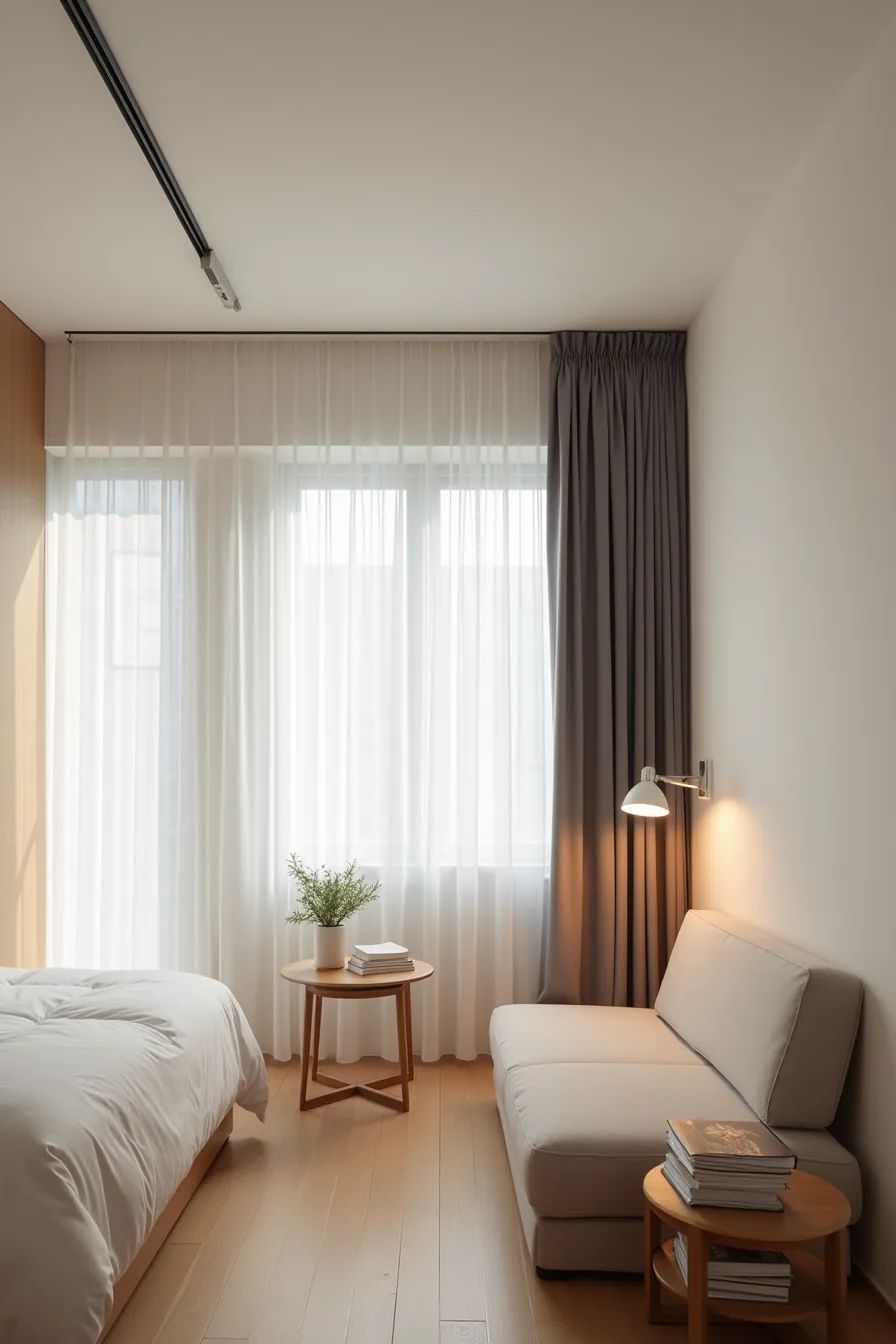
The choice between a sheer voile curtain and an opaque blackout panel is a binary decision about how much daylight you’re willing to sacrifice for visual privacy. A sheer white voile curtain filters morning light into a soft, diffuse glow, reducing glare while preserving the read of your room’s depth. From outside, the window frame remains visible, but the interior dissolves into a blur, enough privacy for daytime separation in a studio, not enough for changing clothes.
An opaque charcoal blackout curtain is the opposite trade-off: it kills the light gradient entirely and turns the divider into a solid wall of shadow. This suits bedrooms where a partner sleeps while you work, or home offices facing a bright morning sun. The dense fabric also muffles sound slightly, roughly 2-3 decibels at mid-range frequencies, which a sheer panel can’t do.
For small spaces, favor sheers; they let you split the floor plan without shrinking the perceived volume of the room. For large, sun-flooded lofts, opaque panels give you control over ambiance rather than just line-of-sight.
Freestanding Curtain Rods for Renters and Quick Setups

When you can’t drill into walls, a tension rod with a weighted base is the fastest route to a curtain separation room divider. This setup relies on pressure and gravity rather than hardware: the rod wedges between two opposing walls at shoulder height, and the base anchors it to the floor. A mid-weight linen panel hanging from the rod gives you a clean, opaque line of separation without leaving a single screw hole behind.
This configuration suits renters, dorm residents, or anyone testing a layout before committing. The tension rod installs in under five minutes and removes just as quickly, making it ideal for seasonal room rearrangements or temporary guest privacy. Look for rods rated to hold 20-40 pounds of fabric; a heavier blackout curtain will require a sturdier base and could sag over time.
Placement matters, mount it between walls that are 5-8 feet apart for optimal stability, and keep the weighted base clear of high-traffic paths where it could be knocked over.
Studio Apartment Divider Strategies Using Layered Curtains

The most effective studio apartment divider relies on a double curtain track holding two layers: a sheer inner panel and an opaque outer panel. This setup lets you control privacy in stages, sheers diffuse harsh morning light while still letting you see the room’s full footprint, and the opaque layer provides total visual separation when you need to hide a sleeping nook or a messy desk.
Layer both panels on the same track rather than installing separate rods; this reduces hardware bulk and keeps the visual line clean. Pull the sheer layer fully open during the day to maintain airflow and the illusion of a larger space, then close the opaque layer only at specific times, overnight or during video calls. The key is proportional stacking: panels should puddle no more than 2-3 inches on the floor, and the track should extend 6-12 inches past the opening on each side to block sightlines completely.
This dual-layer approach suits anyone who needs adjustable privacy in a compact footprint, particularly if you work from home in the same room where you sleep.
Fabric Selection and Color Matching for Room Division

The flat-lay of three swatches draped over a neutral linen chair, sage heavyweight linen, charcoal cotton blend, and cream linen-viscose, captures the core choices you’ll face. Weight determines function: heavyweight linen (typically 10–14 oz per square yard) blocks more light and muffles sound, making it suitable for a bedroom alcove where you need real visual separation. Medium-weight cotton blends around 7–9 oz strike a balance between drape and opacity, ideal for living-room zones where you want division without a heavy feel.
Color matching goes beyond picking a shade you like. A charcoal panel reads as a deliberate architectural element, anchoring the divider as a fixed feature; a sage or cream tone recedes, letting the curtain feel like soft textile rather than a wall. If your room has dark floors or trim, choose a curtain two to three shades lighter to avoid a cave effect.
For durability, check the fabric’s abrasion resistance, linen and cotton blends hold up better than viscose in high-touch areas, and all three swatches here are machine-washable cold, though heavyweight linen should be line-dried to prevent shrinkage.
Scaling Curtain Room Dividers for Flexible Everyday Privacy

In a medium-sized bedroom, a single wall-mounted rod positioned 3 feet from the corner and a floor-length curtain panel drawn across half the room create a dressing alcove without a permanent wall. The rod mounts at roughly 8 feet high, with the panel hanging to within a half-inch of the floor. This setup works because the rod anchors firmly to the wall at one end, eliminating the need for a freestanding frame that would consume valuable floor space, while the 3-foot corner offset leaves enough room for a dresser or chair behind the curtain.
For smaller rooms, compress the rod-to-corner distance to 2 feet and choose a panel width of 54–60 inches instead of a full 8-foot span. In large open-plan spaces, scale up by running two panels on a ceiling-mounted track, each 72–84 inches wide, which lets you pull them shut for complete enclosure or stack them fully open against one wall. Maintenance stays simple: dust the rod weekly and wash the panel every 8–10 weeks per the fabric label, checking the mounting brackets twice a year for loosening.
Your First Move
You now have six distinct ways to divide a room with curtains, from tension rods to ceiling tracks. Each option trades cost against permanence, so match your choice to your lease terms and how long you plan to stay.
Measure your wall span and ceiling height before buying anything, this determines rod diameter and track length. A standard 8-foot ceiling needs an 84-inch curtain panel; anything shorter looks awkward.
Start with the least expensive, fully reversible option: a tension rod and lightweight panels. If it works, you’re done. If not, you’ve lost under $50 and learned exactly what your space demands.
Frequently Asked Questions
Can you use regular curtains as room dividers, or do they need special hardware?
Regular curtains work fine. Use a heavy-duty tension rod for doorways or a ceiling-mounted track for larger spans. Standard drapery hardware supports most fabrics, but ensure brackets are rated for the curtain’s weight.
How much space does a curtain divider take up compared to a solid wall or folding screen?
A curtain divider consumes roughly 4–6 inches of floor depth when closed, versus 2–4 feet for a folding screen. A solid wall takes zero floor space but permanently divides the room. Curtains are the slimmest temporary option.
What’s the best way to hang curtain dividers in a rental without damaging walls?
Use a ceiling-mounted tension rod between two walls, or adhesive hooks rated for 10–15 pounds per pair. For wider spans, install a freestanding floor-to-ceiling pole system with weighted bases, no drilling required.
Do sheer curtain dividers provide enough privacy for a bedroom or home office?
Sheers block visual outlines but not light or sound. They suit a home office where you need separation without darkness. For a bedroom, layer sheers with blackout panels or choose a heavier linen (200+ thread count) to reduce visibility.