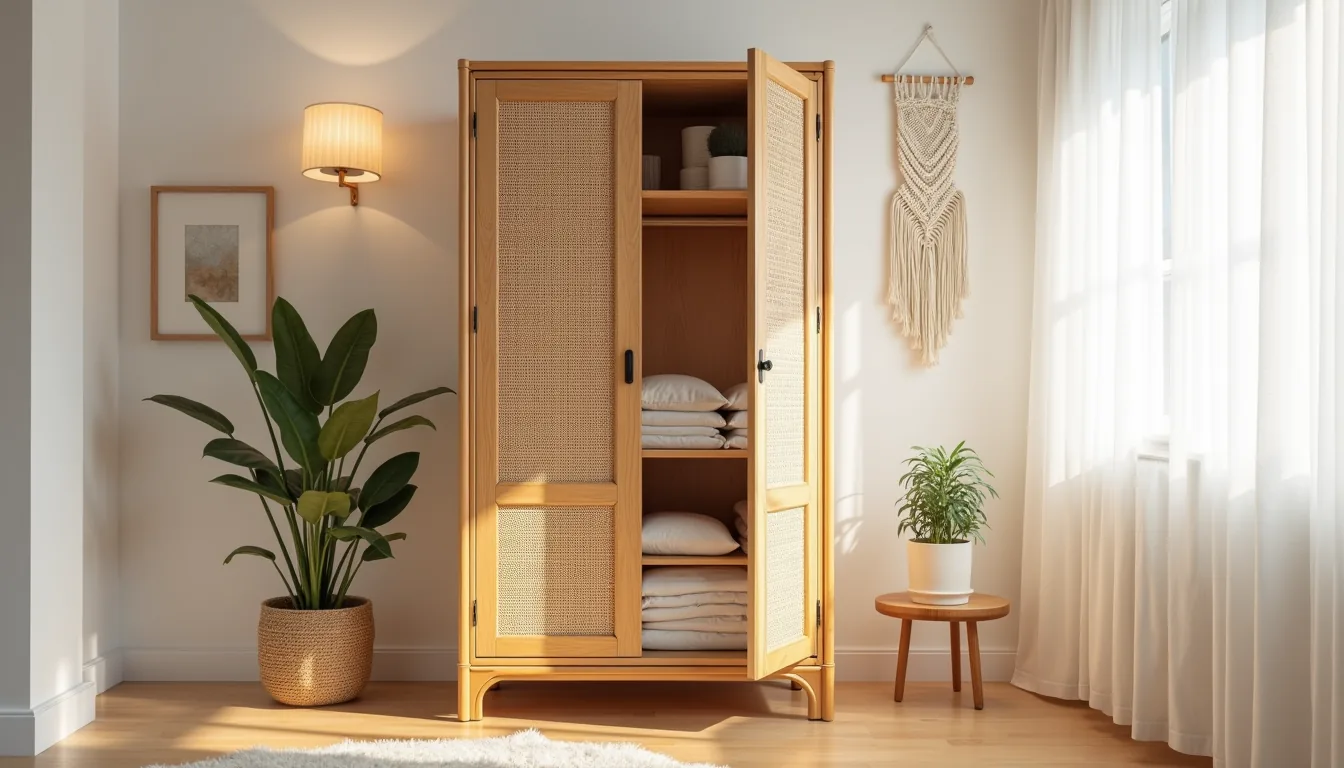

A rattan wardrobe, a freestanding or built-in unit that pairs woven natural fibers with a sturdy wood frame, solves the storage problem without surrendering an inch of style, whether your room runs on boho warmth, modern minimalism, or something in between. But the term covers far more than one look: it spans open shelving, sliding-door panels, and full-height built-ins, each with distinct space, budget, and maintenance demands. The six approaches below break down exactly what works, who it suits, and what installation or care each requires, so you can match the right interpretation to your room before you buy or build.
Key takeaways
- Rattan wardrobes suit boho bedrooms best when paired with linen bedding, jute rugs, and warm wood tones, but avoid matching them with cold gray or stark white minimalist decor.
- A painted rattan wardrobe (using a matte chalk or latex paint) gives you the woven texture without the tropical look, and it holds up better in humidity if you seal it with a clear polyurethane coat.
- For small spaces, a built-in rattan wardrobe with sliding doors saves 24–30 inches of swing clearance compared to hinged options, and you can mount it floor-to-ceiling to double your usable storage.
- Budget and renting are best served by a freestanding rattan armoire (typically $200–$600) that requires no wall anchoring, while a long-term investment in solid rattan or cane over particleboard will last 10–15 years with annual dusting and occasional re-oiling.
Natural Rattan Wardrobe in a Boho Bedroom Pairing
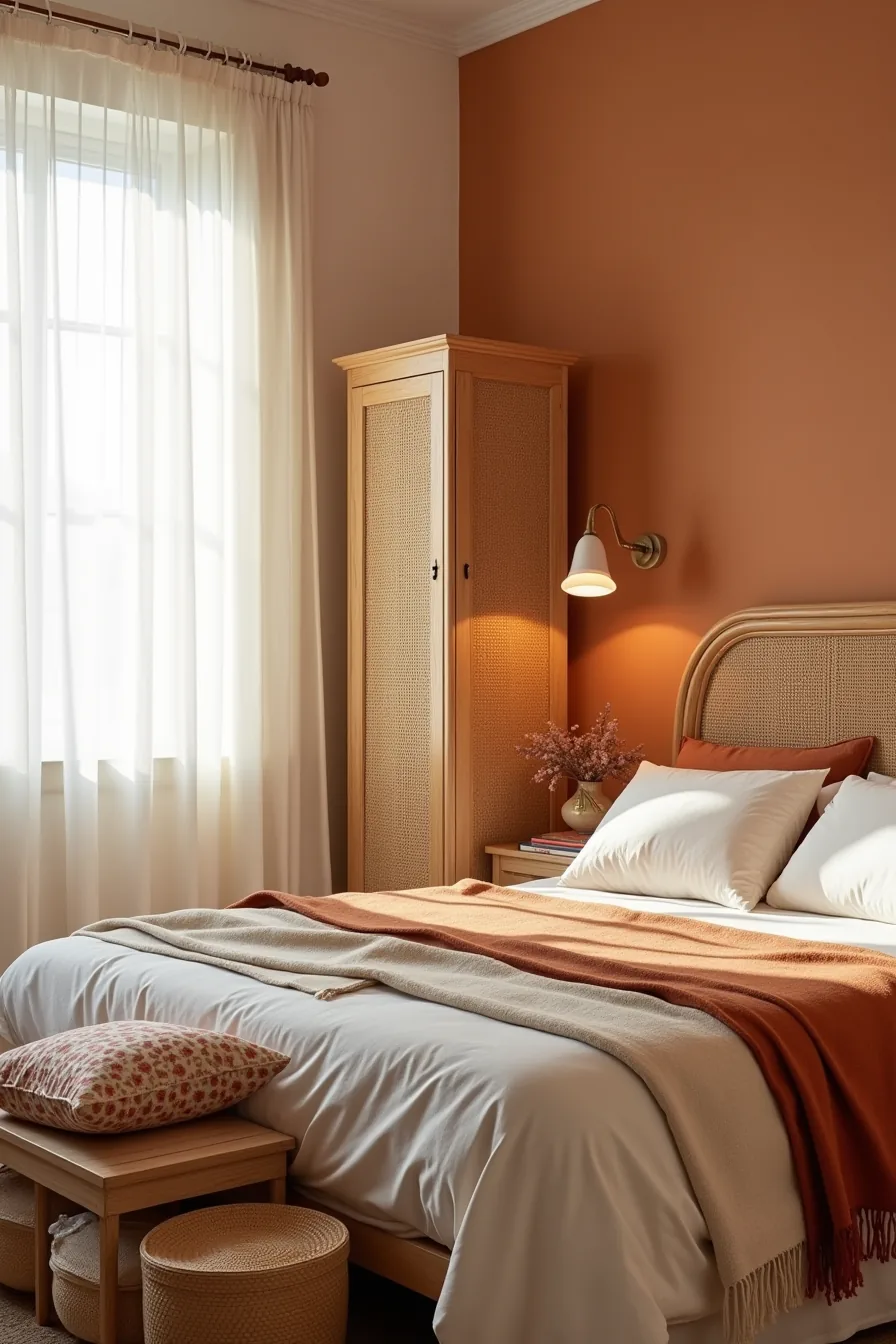
A natural rattan wardrobe anchors a boho bedroom precisely because it refuses to compete with the room’s layered chaos. The untreated cane’s warm honey tones absorb visual noise, letting a cream linen bedspread, rust throw blanket, and patterned floor cushion carry the color story without overwhelming the space.
Position the wardrobe against an ochre-painted wall, as seen beside the low wooden bed frame, and let woven baskets stacked at its base bridge the gap between storage and decor. This pairing works because natural rattan shares the same earthy palette as terracotta, sand, and burnt sienna, so your bedroom reads as intentional rather than cluttered.
For scale, choose a wardrobe that stands roughly 5.5 to 6 feet tall in a standard bedroom; anything shorter reads as accent furniture, and taller pieces dominate a low-ceilinged room. Leave at least 24 inches of clear floor space in front of the doors to allow full swing and easy access to hanging clothes. If your bed frame sits low like the one pictured, add a floor cushion or two nearby to create a seating nook that softens the transition between furniture heights.
Painted Rattan Wardrobe for Warm Modern Texture
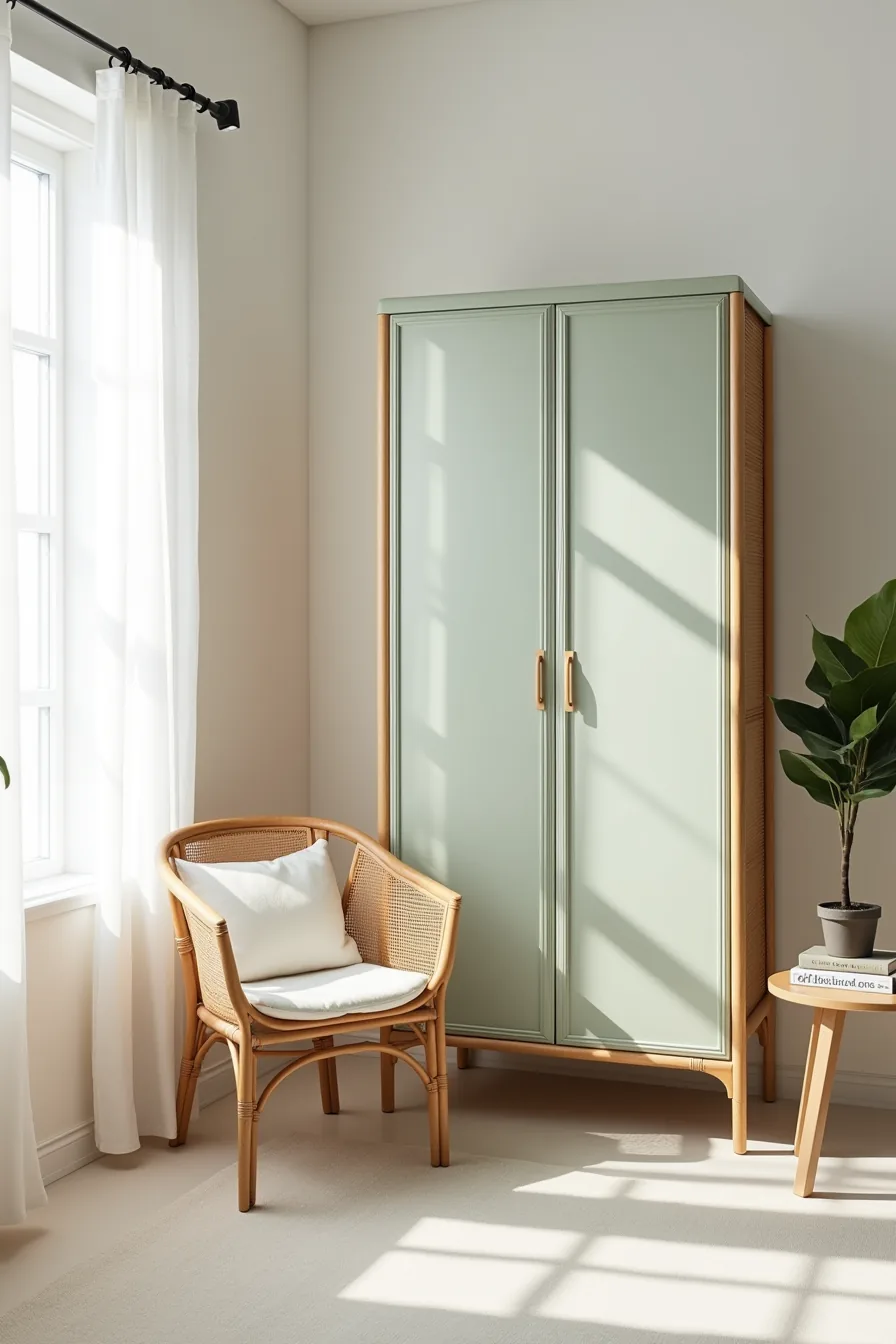
A soft-finish paint transforms rattan from rustic to refined. Choose matte or satin over high-gloss, the subtle sheen lets the natural weave cast gentle shadows, which is what gives a painted piece that warm modern texture instead of a flat, plastic-like appearance. Sage, dusty terracotta, and warm putty work best because they echo the organic tones already present in rattan’s fiber.
Imagine a matte sage-painted rattan wardrobe in a bright corner, a minimalist white linen chair positioned to its left, and a single potted fiddle leaf fig on a low side table beside it. The clean white walls let the painted weave read as sculptural rather than loud. This setup suits a modern living room or a transitional bedroom where you want warmth without the full boho commitment.
Durability is the trade-off. Painted rattan hides stains better than natural cane, but the finish will chip at high-contact edges, door pulls, corners, within two to three years of daily use. Budget for a touch-up kit at purchase.
Also note that paint fills the weave slightly, reducing airflow; keep the wardrobe in a climate-controlled room, not a humid garage, to prevent trapped moisture from warping the frame.
Rattan Wardrobe for Airy Summer Bedrooms
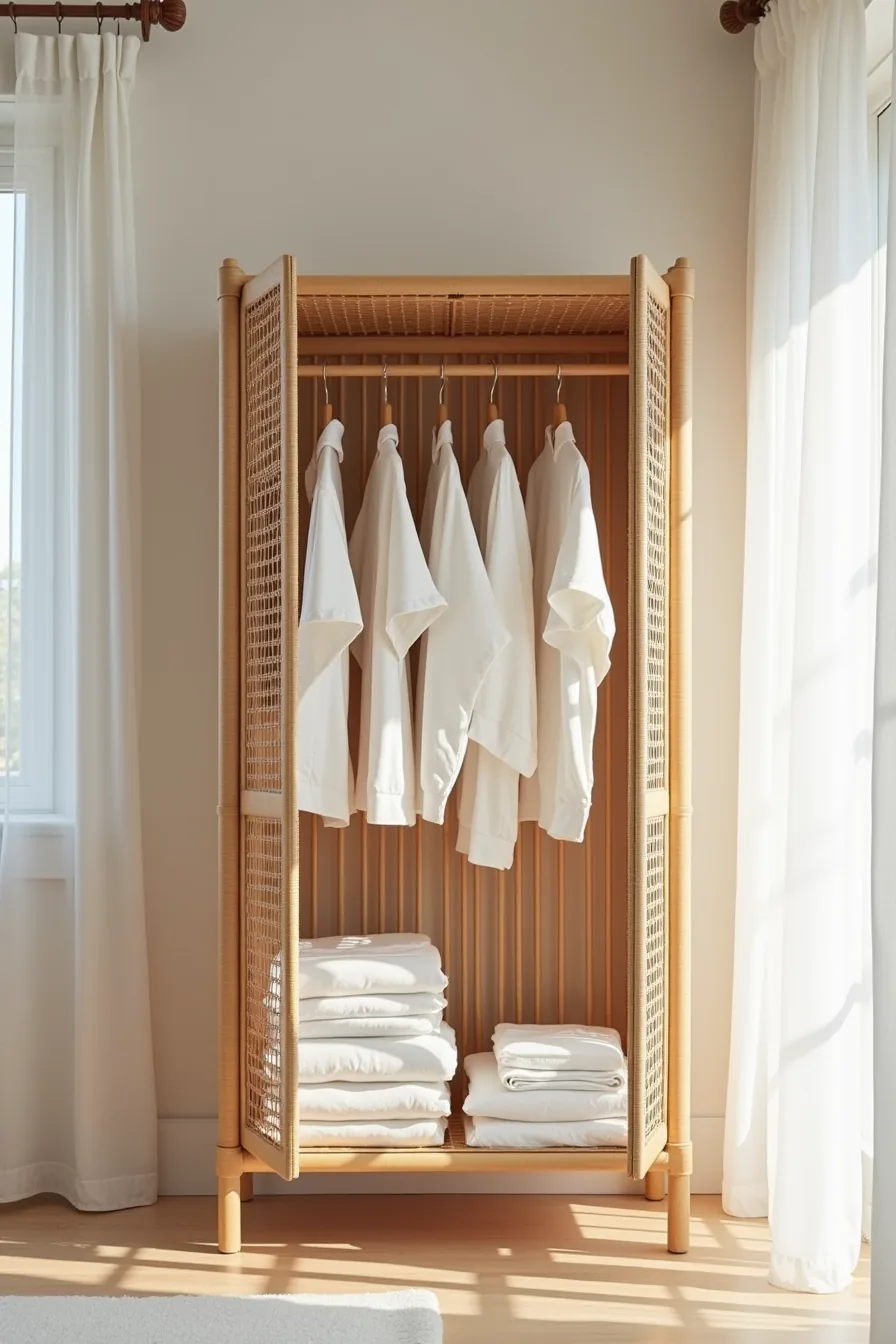
An open-weave rattan wardrobe changes the feel of a compact bedroom entirely. Unlike solid wood or painted panel doors, the slatted construction lets light pass through the weave, so a small room reads as larger rather than boxed in. This makes it the right choice for warm climates or spaces that get stuffy by mid-afternoon, the gaps also allow steady airflow, which keeps stored cotton and linen from developing that damp, musty smell.
In the example you see here, the wardrobe features slatted side panels and thin vertical supports, with white cotton garments hanging freely inside and pale linen stacked on lower shelves. A sheer white curtain sits behind the piece, and pale wooden floorboards run underneath. That combination works because every element shares the same light visual weight, the open weave, the white fabric, and the sheer curtain all let light move through, so the wardrobe becomes a soft partition rather than a solid block.
Styling constraints matter. Because the interior is visible, you need to commit to a disciplined palette, white, cream, or faded pastels only. Patterned or dark clothing will fragment the airy effect and make the open weave look cluttered.
You also need roughly 24 inches of clearance in front for the doors to swing fully; in a tight bedroom, use the slatted side panels as the primary access and treat the front doors as secondary.
Built-In Rattan Wardrobe for Small Spaces
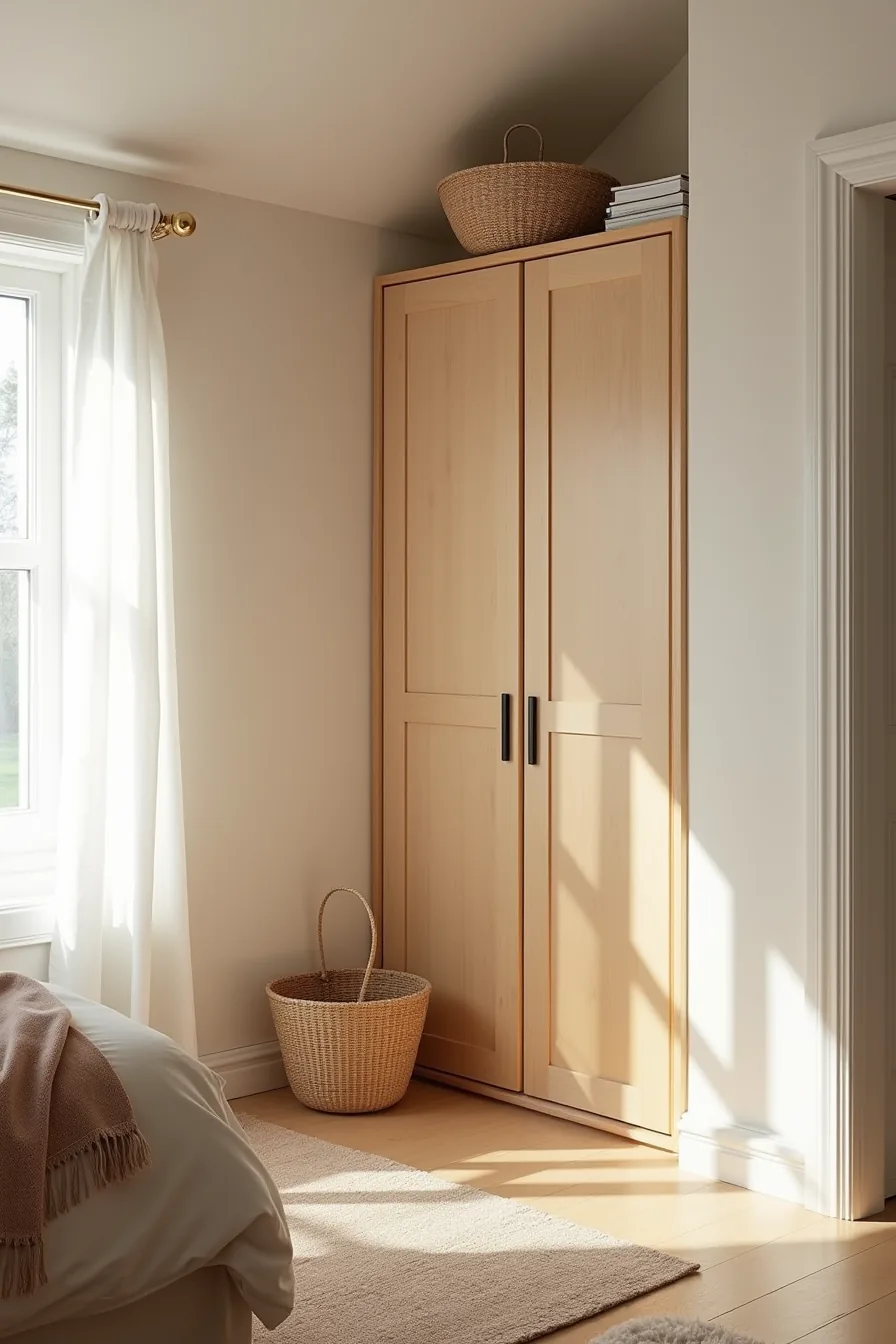
A built-in rattan wardrobe solves the awkward geometry of alcoves and sloped ceilings that standard freestanding pieces can’t fit. In the example here, the wardrobe sits flush within an alcove, its doors aligned with the surrounding wall paneling, so the unit reads as architecture rather than furniture. The compact woven baskets on the floor beside it pick up the rattan’s natural tones and add hidden storage for items you don’t want on display.
The measuring tape draped across the top edge underscores the critical step: measure the alcove’s width at three points, floor, middle, and ceiling height, because walls and floors rarely sit perfectly square. For a sloped ceiling, build the wardrobe’s height to match the lowest clearance point, then use the upper triangular space for rarely accessed bins. You’ll need roughly 60-90 cm of floor depth for standard hanging clothes, but you can trim that to 50 cm if you use shallow-depth hangers or front-facing shelving.
A semi-custom approach, ordering rattan door fronts and having a carpenter build the carcass, typically costs less than fully bespoke joinery and still gives you a precise fit. If you’re renting, skip permanent construction: use a freestanding rattan armoire that happens to fit the alcove, and anchor it to the wall with anti-tip brackets to meet safety codes.
Rattan Wardrobe as a Room Divider or Accent Wall
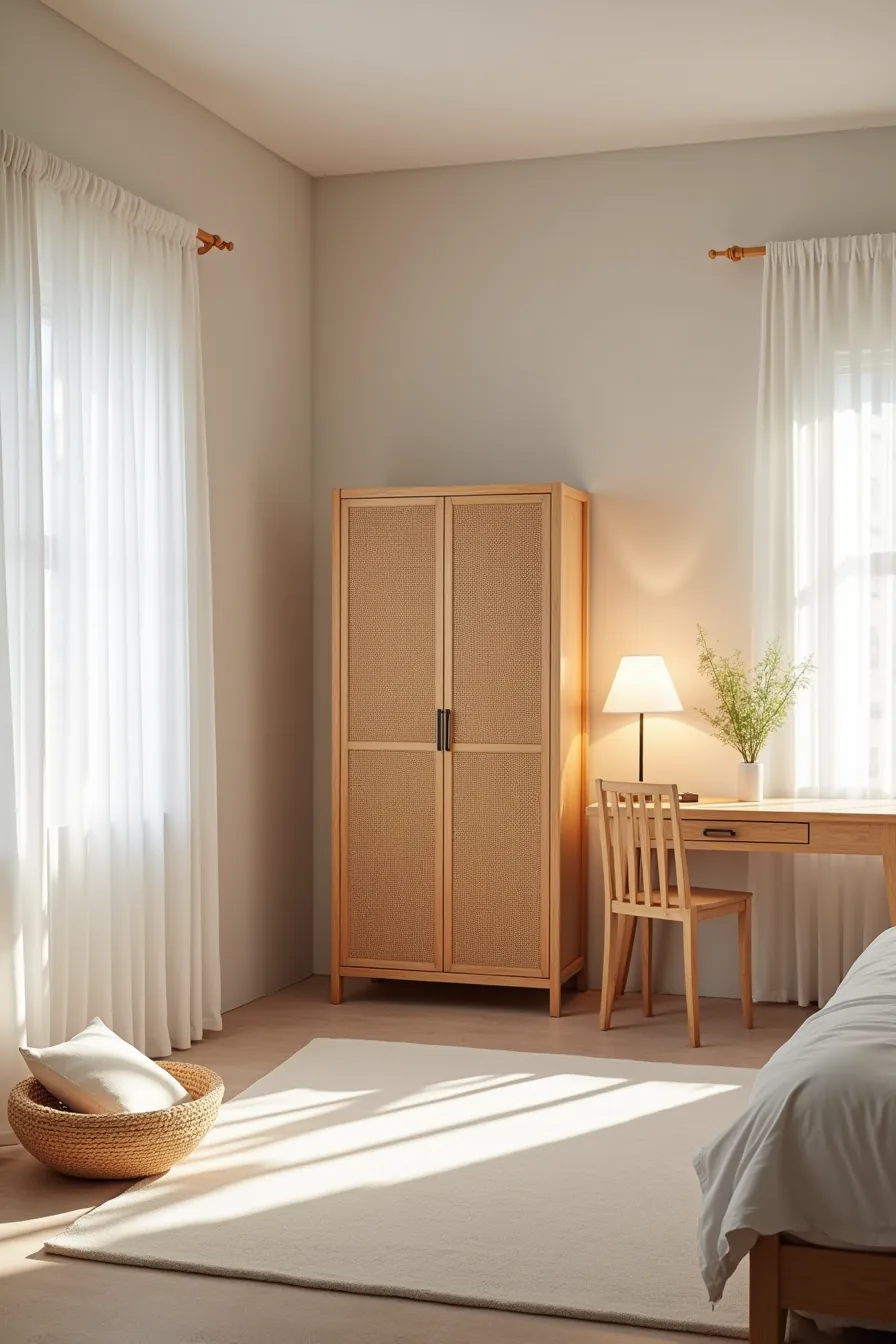
A tall, freestanding rattan wardrobe works best as a room divider when you need to carve out a private workspace from a combined living area. Positioned perpendicular to the camera, the unit blocks sightlines to the desk and chair behind it, letting you work without visual distraction while the low seating area with cushions and a small table stays open and social on the other side. The semi-transparent weave filters light rather than blocking it, so the room doesn’t feel like two cramped boxes.
For placement, allow at least 80-100 cm of clearance on the circulation side so foot traffic never funnels through the seating zone. Choose a wardrobe that reaches 180-210 cm tall if you want true visual separation; anything shorter reads as a decorative accent, which suits a medium-sized bedroom but won’t define zones in a large open-plan living area. Because rattan is hollow-core, the unit supports only lightweight hanging clothes and folded linens, never heavy coats or books stacked on shelves, so weight capacity sits around 30-50 kg depending on frame thickness.
If your floor isn’t level, use adjustable feet to prevent the doors from racking, and anchor the top to the wall with anti-tip straps if you’ve children or pets, even in a mid-room position.
Maintenance, Durability, and Long-Term Investment
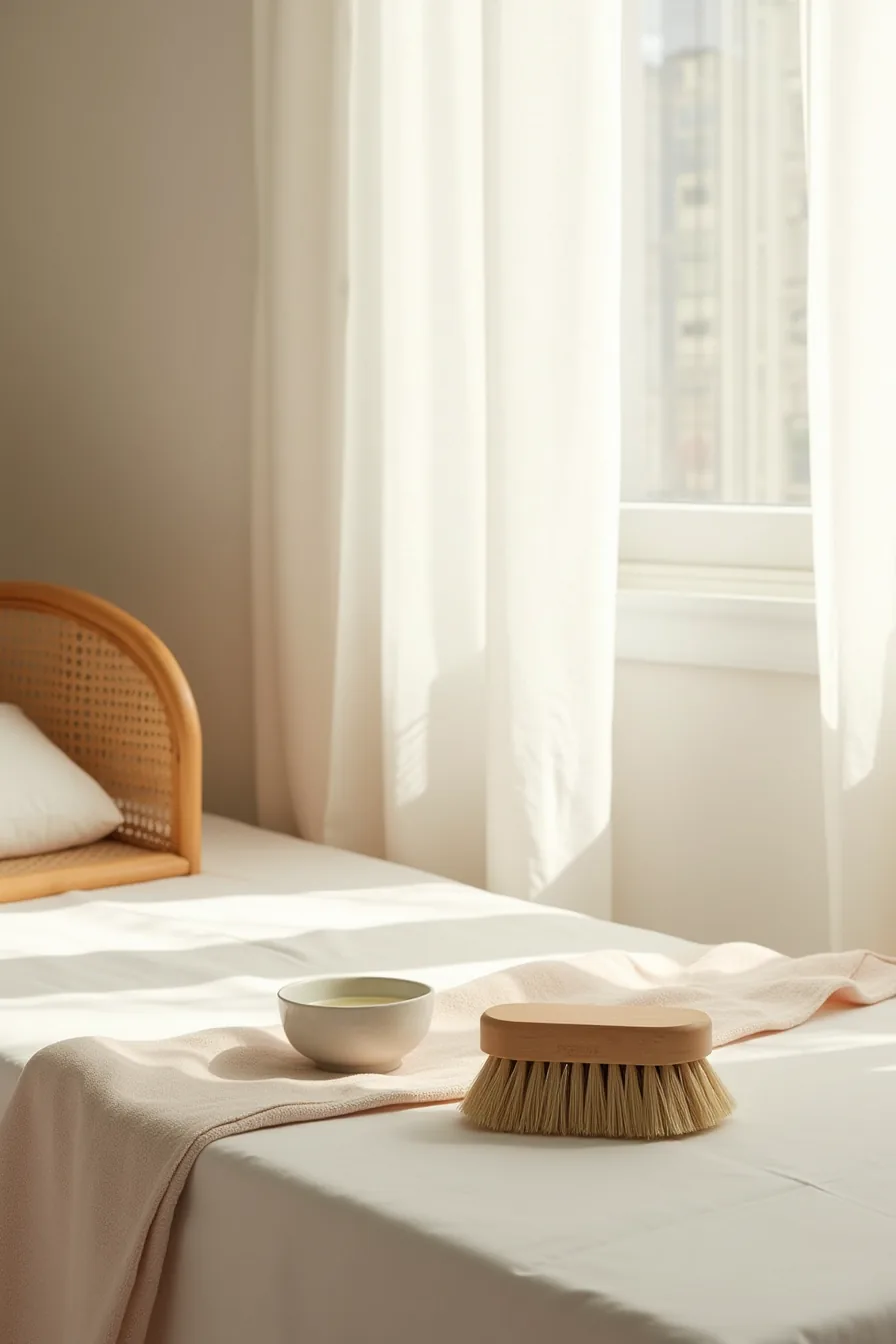
Your cleaning cadence depends on dust load. In a typical bedroom, give the weave a weekly pass with a soft-bristled brush to dislodge particles from the crevices; a cotton cloth dampened with a bowl of plain water handles monthly wipe-downs. Skip chemical polishes, they leave a film that attracts grime and can darken the natural fibers unevenly.
Rattan is sensitive to humidity swings. Keep the wardrobe in a room that stays between 40–60 percent relative humidity; prolonged exposure above that causes the weave to sag and loosen, while below it, the fibers dry and crack. Avoid placing it against an exterior wall or near a radiator.
If you notice minor wear on a corner, sand the rough edge with fine-grit paper and seal it with clear furniture wax. Pest risk is low in dry climates, but a yearly inspection for powderpost beetles, look for fine sawdust beneath joints, justifies the five minutes it takes.
Budget pieces (typically $150–$300) use thinner, machine-wrapped cane and will need replacement within 3–5 years of daily use. Mid-range wardrobes ($400–$800) with kiln-dried hardwood frames hold up for a decade when maintained. Heirloom-quality examples, often with hand-woven cane and solid wood joinery, run $1,200 and up; those are repairable for life.
When doors start racking or joints loosen, repair costs run roughly 15–30 percent of a new unit’s price, if the frame is sound, fix it; if the weave has torn in multiple spots, replacing is the smarter spend. For a long-term investment route, buy the mid-range option and budget $50–$100 for professional re-caning once at the eight-year mark.
Your Decision Checklist
Before you buy, measure your floor space and door swing clearance, a 24-inch-deep wardrobe needs at least 36 inches of walkway in front. Check the rattan weave density: tighter weaves hide dust better and last longer. Match the frame finish to your existing hardware, not your wall color.
Where to start
Pick one room and one budget first. If you rent, choose a freestanding piece under 60 inches tall that clears your ceiling molding. For a permanent home, invest in solid wood with rattan panels you can replace.
Your next step: measure your bedroom’s longest wall today, write down the number, and compare it against the three wardrobe widths you’re considering. That single measurement will eliminate half your options instantly.
Frequently Asked Questions
Does natural rattan wardrobe need sealing or treatment to resist moisture and insects?
Yes. Apply a clear polyurethane or wax finish annually to seal rattan against humidity and pests. Skip it in dry climates, but in coastal or tropical areas, sealing is non-negotiable for longevity.
Can you paint or stain a rattan wardrobe, and will it peel or crack over time?
Yes, you can, using spray paint or wood stain with a primer. It won’t peel if prepped and sealed properly, but cracking occurs if you paint over wet or dirty rattan. Use a flexible topcoat to prevent chipping.
What is the typical weight capacity of a rattan wardrobe shelf, and how does it compare to solid wood?
A woven rattan shelf typically holds 15–30 pounds (7–14 kg) per level, which is 40–60% less than a solid wood shelf. Use the top and hanging rod for heavier items, and reserve shelves for folded clothing or accessories.
Is a rattan wardrobe suitable for renters, or does it require permanent installation?
It’s renter-friendly if you choose a freestanding, flat-pack model. Most styles slide into place without wall anchors, so you avoid drilling. Skip built-in rattan wardrobes, which need permanent frames and wall mounting.